


The crisis AGI produces is not primarily economic. It is philosophical. And the philosophical answers we have been reaching for; the leisure answer, the creativity answer, the uniquely-human answer; are each, in important ways, inadequate. A new framework is needed. The research is beginning to point toward one. Why we need a new philosophy of work, and why the answers we already have are not going to be enough.
For as long as anyone alive can remember, the story of a life well lived has been organized around the same three elements: effort, mastery, and contribution. You work hard. You get good at something. You offer that something to the world, and the world gives you back a sense of worth. The arrangement was never perfectly fair; access to work that actually rewarded mastery was always distributed unequally; but as a cultural compact, as a shared understanding of how meaning was supposed to flow, it was remarkably stable across time, across class, across ideology.
AGI is stress-testing all of it at once. Not just the economic logic, that is the conversation we are already having, but the philosophical foundations that the economic logic was resting on. The assumption that mastery has intrinsic value. The assumption that productive contribution is the natural engine of self-worth. The assumption that the things human beings are good at matter, in a world where a machine might be good at them too.
I. The Three Pillars of Everything We Built
Industrialization did not invent the cultural compact between labor and meaning; it inherited it from older arrangements, simplified it, and made it universal. Before the factory, the compact lived in the guild, the farm, the monastery, the craft workshop: you brought your effort and attention to a practice; the practice returned mastery; the mastery returned worth. The industrial era compressed this into a single word: work.
And work, for two centuries, delivered. Not equally or fairly — the distribution of meaningful work has always tracked the distribution of power — but reliably enough that the compact became the invisible structure on which most of modern life was built. We organized education around preparing people for it. We organized social identity around it. We organized architecture and urban planning around it. We built our selfhood around it so thoroughly that “what do you do?” became the default question of first encounter in almost every professional culture on earth.
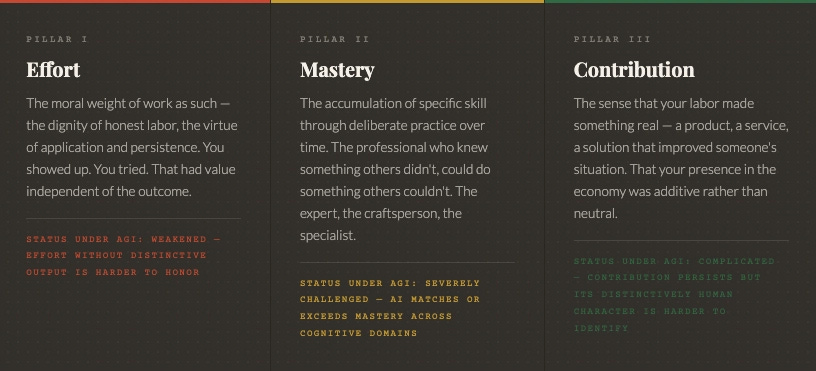
The compact worked because each pillar reinforced the others. Effort produced mastery; mastery enabled contribution; contribution justified the effort. The loop was self-sustaining and, for most of the industrial era, self-evidently true. You could be certain that what you were good at mattered, because the economy needed what you were good at. That certainty is now in question; not everywhere, not for everyone, but enough that the philosophical foundations it was resting on have begun to show.
II. Not Just Automation, A Challenge to the Premise
Previous waves of automation challenged the labor market. They displaced specific categories of work, forcing adaptation and transition. The cultural compact survived these disruptions because the response was always the same: humans moved to higher-order work, work that required judgment, creativity, or emotional intelligence, domains where the case for human mastery could be re-established on new terrain.
AGI is different not because it automates more jobs but because it challenges the premise underlying every previous adaptation. There is no obvious “higher-order work” to move into when the system performing the displacement is capable of judgment, creativity, and — in simulated form — emotional attunement across almost any domain.
A 2025 paper in AI & Ethics (Springer) makes this argument in its most direct form. The paper examines traditional philosophical accounts of what makes a life meaningful; narrative accounts, engagement accounts, purpose accounts; and asks which of them survive in a world with superintelligent AI. Its conclusion is unsettling: all of them are disrupted, and in different ways.
Research Note
On AI and narrative accounts of meaning: The AI & Ethics paper examines several prominent philosophical theories of what makes life meaningful. Narrative accounts; which hold that life gains meaning through the coherent story we construct about our growth, achievements, and contribution; are specifically challenged by AGI: if the chapters of that narrative (skill development, professional achievement, contribution through mastery) are no longer distinctively human, the narrative coherence is harder to construct. Engagement accounts, which ground meaning in the experience of deep involvement with challenging activities, face a related problem: the challenge that produced the engagement has been removed. Purpose accounts, which locate meaning in contribution to something larger than oneself, are more resilient; but require significant respecification of what kind of contribution counts as distinctively human.
Source: “Superintelligent AI and Meaning in Life,” AI & Ethics, Springer, 2025
A 2024 paper in Philosophical Studies (Springer) approaches the same territory from a different angle, through what it calls “existentialist risk.” The argument is not that AI will physically harm us, but that a misaligned AI system could threaten the very structures through which humans construct meaning, even while being technically “safe” by conventional safety standards. An AI that optimizes for human stated preferences, for example, could deliver a world that satisfies those preferences while systematically undermining the conditions; challenge, growth, genuine contribution; under which human flourishing actually occurs.
Research Note
On existentialist risk and value misalignment: The Philosophical Studies paper argues that AI safety research has focused almost exclusively on catastrophic physical harms, while a category of risk it calls “existentialist risk”; harm to the meaning structures through which humans understand their lives; has received almost no formal attention. The paper distinguishes between preferences (what people say they want) and values (what actually constitutes their flourishing), arguing that these can diverge significantly. An AI aligned with preferences but not values could systematically deliver the former while undermining the latter; producing comfort, entertainment, and convenience at the expense of the challenge, growth, and genuine contribution that meaning requires.
Source: “Existentialist Risk and Value Misalignment,” Philosophical Studies, Springer, 2024
The problem isn’t that AI takes tasks away from humans. It’s that the tasks it takes were doing something else for us that we hadn’t named, and haven’t yet replaced.
Taken together, these papers paint a picture that is more philosophically serious than most of the mainstream AGI discourse acknowledges. The economic disruption is real and urgent. But beneath it is a philosophical disruption that will outlast any economic solution, because it concerns the story we tell ourselves about what makes human effort worth the effort in the first place.
III. Three Answers We Keep Reaching For, and Their Limits
When the inadequacy of the old compact becomes apparent, the conversation reaches predictably for three answers. Each contains genuine insight. Each also contains a flaw that is serious enough to prevent it from serving as the new foundation the moment actually requires.
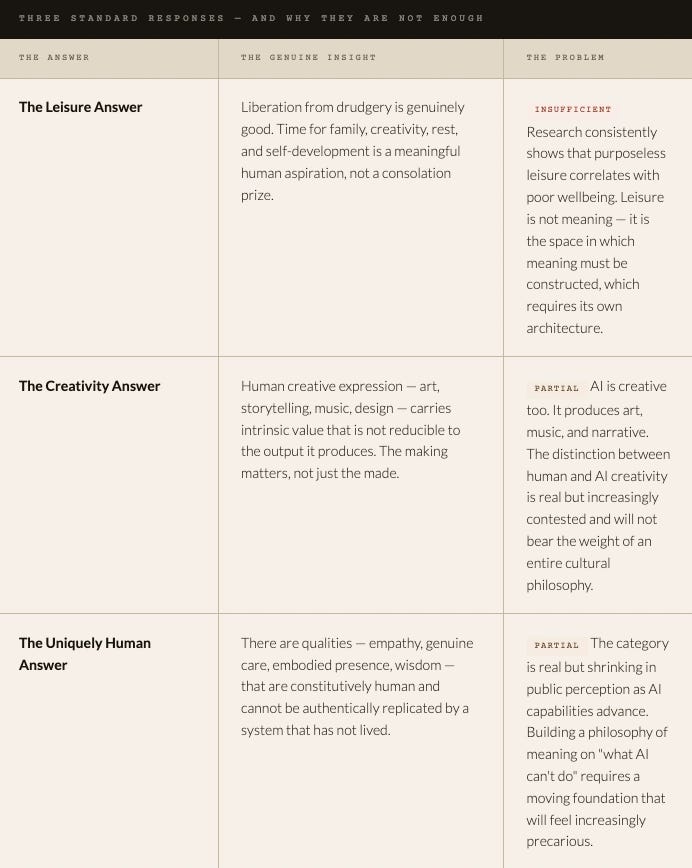
The Journal of Ethics paper on existential unemployment is instructive here. Its argument is not that leisure is bad; it is that leisure is neutral, and neutrality is not enough. The research on unemployment, early retirement, and forced idleness consistently shows that what people miss is not the work itself but what the work delivered: structure, social connection, a sense of contribution, the daily experience of being needed. These are not things that free time automatically provides. They must be deliberately constructed. And we have not yet built the cultural or institutional infrastructure for constructing them.
The Deeper Problem with the Existing Answers
Each of these answers; leisure, creativity, the uniquely human; shares a structural flaw: they are all defensive. They define what human life is for by reference to what AI cannot do, which means they are permanently dependent on that reference point remaining stable. A philosophy of meaning that is defined in opposition to a technology is a philosophy that will require constant revision as the technology changes.
What is needed is not a defensive account (”this is what AI cannot take from us”), but a positive one: this is what human life is for, stated in its own terms, grounded in what actually produces flourishing rather than in the moving boundary of technological capability. The research tradition the AI & Ethics paper is drawing on, the eudaimonist tradition from Aristotle through contemporary psychology, offers the most serious attempt at that positive account. It has not yet been translated into the institutional language that would make it actionable.
IV. What Would a Positive Account Actually Look Like?
The philosophical tradition that comes closest to providing the positive account the moment requires is not new. It is, in fact, among the oldest in the Western canon; and has close parallels in non-Western traditions that arrived at similar conclusions independently. What the current moment demands is not a new philosophy constructed from scratch but the serious application of an ancient one to conditions its original authors could not have foreseen.
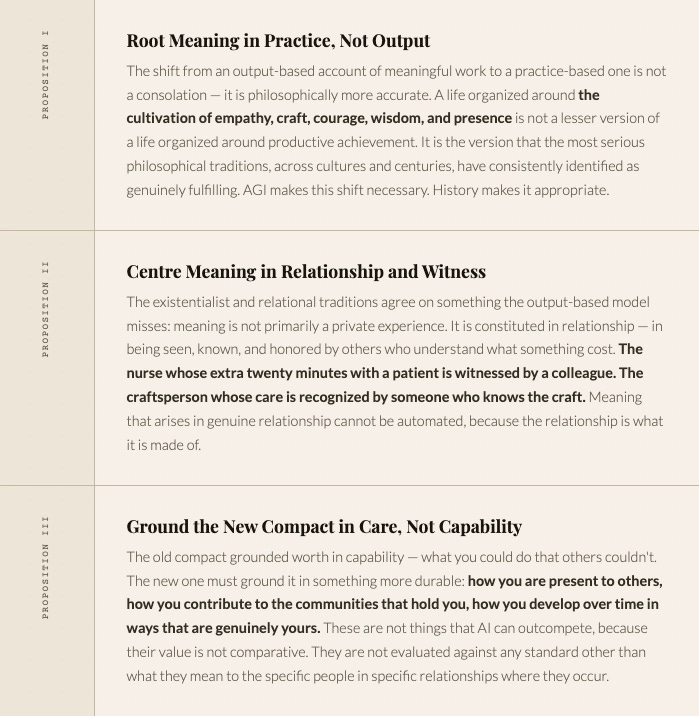
The core insight of the eudaimonist tradition; Aristotle’s account of flourishing, Confucian ethics, the best of the Abrahamic traditions; is that the meaningful life is not defined by what you produce but by what you practice. The word Aristotle uses for the excellent person is not “achiever” or “producer”, it is something closer to “one who is actively exercising their finest capacities.” The emphasis is on activity, on ongoing practice, on the cultivation of character through relationship and community, not on the output that activity yields.
This distinction matters enormously in the AGI context. If meaning comes from output, then AI’s superior output is a genuine threat. If meaning comes from practice, from the daily exercise of specifically human capacities in genuine relationship with others, then AI’s superior output is simply irrelevant to the question. The practice is the point. The output is, at most, evidence that the practice occurred.
What Institutions Would Look Like Built on This
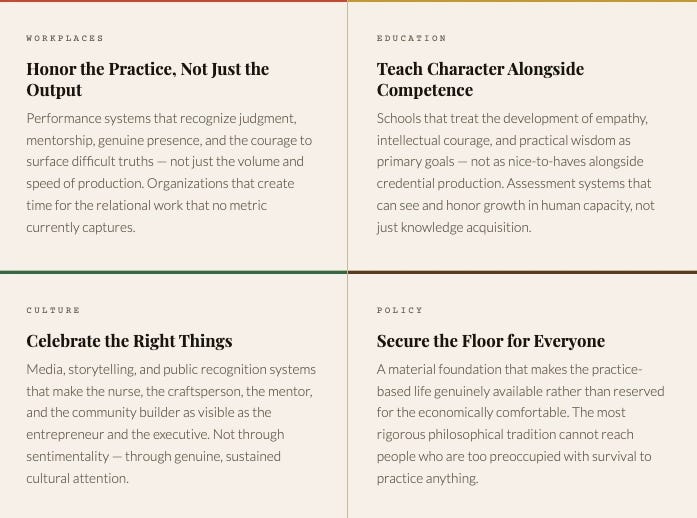
A philosophy of meaning that remains purely individual; something you figure out for yourself, in private, without structural support; is not a philosophy that will reach the people who most need it. The old compact was effective precisely because it was institutionally embedded: schools, workplaces, professions, and cultural narratives all reinforced the same story. A new compact needs the same embedding. What would institutions look like if they were built around the practice-based, relational account of meaning rather than the output-based one?
V. A Question We Deferred
This isn’t a crisis that AGI caused. It is a question that human civilization deferred; consistently, cleverly, and with good reason; for as long as productive necessity made the deferral feel justified. When work itself supplied the meaning, there was no urgency to ask what work was for. The answer was obvious. You could just do it.
AGI has removed the justification for the deferral. Not everywhere, not yet, and not for everyone; but enough that the question can no longer be responsibly postponed. What is human effort for, in a world where machines can perform most of it more efficiently than humans can? The answer that the philosophical tradition consistently points toward; practice, relationship, the cultivation of character in community; is not a new answer. It is the answer that was always waiting to be taken seriously, behind the convenient excuse that material necessity had provided.
The cultural compact between effort, mastery, and contribution was not wrong. It was incomplete. Mastery was always a means, not an end; a way of developing and exercising human capacities in relationship with others and with the world. The end was the exercise, not the superiority. We confused the two, because for most of human history they arrived together. AGI is separating them. And in doing so, it is not destroying meaning. It is revealing, perhaps for the first time with sufficient urgency, where meaning actually lives.
Building the institutions; the workplaces, the schools, the cultural systems, the economic architecture; that can sustain a life built on that revealed foundation is the practical task now before us. It is not a small task. But it is, the research increasingly suggests, the right one.
The question isn’t what happens when AI does everything better. The question is what we were doing all along, and whether we were ever really doing it for the reason we thought.
Disclaimer: This article engages three recent academic papers as its primary sources. Section IV draws on the philosophical tradition these papers invoke, the eudaimonist account of human flourishing, and proposes institutional implications that go beyond what the papers themselves argue. The author takes responsibility for those extensions.
Primary Sources:
“Superintelligent AI and Meaning in Life“ — AI & Ethics, Springer, 2025
“Existentialist Risk and Value Misalignment“ — Philosophical Studies, Springer, 2024
“All Play and No Work? AI and Existential Unemployment“ — Journal of Ethics, Springer, 2025
Intellectual Lineage:
Aristotle — Nicomachean Ethics
Frankl — Man’s Search for Meaning
Confucius — Analects
The Great Game series — “The Oldest Game“ and “On the Deliberate Cultivation of Human Excellence“ (for the philosophical and institutional framework suggested in Section IV)