


Between 1935 and 1943, the United States built, and then systematically dismantled, the most ambitious state-administered meaning infrastructure in democratic history. Understanding exactly how it was built, exactly why it failed, and exactly what survived tells us more about the structural requirements of the Great Game than any amount of philosophical argument.
40,000 artists, writers & musicians employed at WPA peak.
30M people reached by Federal Theatre Project, most seeing live theater for the first time.
3M young men enrolled in Civilian Conservation Corps over its lifetime.
2,300 interviews with formerly enslaved people collected by Federal Writers’ Project, largest such archive ever assembled.
1 FAP-era community art center still operating today.
The New Deal’s meaning infrastructure was not designed as such. It emerged from a specific crisis; 25% unemployment, a broken economy, a generation of artists, writers, musicians, and young men with neither work nor purpose; and took the form it took because that is what the crisis demanded. But in addressing the material crisis, it accidentally built something that the series has been arguing humanity must build deliberately: a state-supported, publicly visible, community-reaching system for honoring specifically human capacities and making their development economically and socially viable.
At its height, the WPA Federal Arts Projects employed 40,000 artists, writers, musicians, and theater workers. The Federal Theatre Project reached audiences of 30 million people, most of whom had never seen live theater in their lives. The Federal Writers’ Project employed Zora Neale Hurston to document African American folklore and Ralph Ellison to collect oral histories in Harlem. The Civilian Conservation Corps gave three million young men from broken Depression families the experience of mastery, community, physical challenge, and visible contribution to a landscape they would never own but would always know they had shaped. The post office in almost every American town acquired a mural showing its citizens who they were.
By 1943, almost all of it was gone. The Federal Theatre Project had been killed by a single Congressional vote in 1939. The other programs had been defunded, restructured, or quietly absorbed. The communities that had been served by these programs had no institutional infrastructure to continue without state support. The practitioners who had found in them a livelihood for specifically human work were dispersed into universities, commercial markets, or silence. What the series calls the capture pattern operated here not as corruption from within but as political attack from without, and the programs had no structural defenses capable of surviving it.
I. What the New Deal Actually Constructed
The five programs that constituted the New Deal’s meaning infrastructure each addressed a different dimension of the problem. Together they formed something coherent; not by design, but by the convergent logic of what human beings need when material necessity is met without the scaffolding of purpose.
(1935–1943) Federal Art Project
5,300 artists · 108,099 paintings · 2,566 murals
The FAP placed art in public civic spaces; post offices, courthouses, schools; and established community art centers in places that had never had them. At peak, 100 centers operated nationally, many in rural areas and Black communities that the commercial art world had never reached.
Jackson Pollock, Mark Rothko, Jacob Lawrence, and Charles White all developed their early work under FAP employment. The Harlem Art Workshop. The South Side Community Art Center in Chicago, which would become the only FAP-era institution still operating today.
(1935–1943) Federal Writers’ Project
6,600 writers · 51 American Guides · 2,900 oral histories
The FWP made Americans visible to themselves; through state guidebooks that documented places no one had documented, oral histories that recorded the lives of ordinary people, and the Slave Narrative Collection that assembled the largest archive of formerly enslaved people’s testimony in history.
Zora Neale Hurston documenting folklore in the Deep South. Ralph Ellison collecting oral histories in Harlem. Studs Terkel beginning the practice that would define his career. Richard Wright and Saul Bellow paid to write when no market would yet pay them.
(1935–1939) Federal Theatre Project
12,000 workers · 1,200 productions · 30M audience members
Directed by Hallie Flanagan, the FTP created theater for people who had never seen it; free or nearly free, in cities and towns across the country. The Living Newspapers were documentary theater about current events, produced with the urgency and craft of great journalism.
Orson Welles’ “Voodoo” Macbeth; an all-Black production set in Haiti, performed at the Lafayette Theatre in Harlem to audiences who walked past the theater every day but had never entered it. One-Third of a Nation, reaching audiences of 100,000 in a single run, about housing conditions in American cities.
(1935–1943) Federal Music Project
15,000 musicians · 132K students/week · dozens of new orchestras
The FMP created orchestras in cities that had none, brought music education to schools that could not afford it, and documented folk traditions that were disappearing. It performed 225,000 concerts in its first year, most of them for audiences who had never attended a live musical performance.
Alan Lomax working through FMP-adjacent infrastructure to document American folk music. New orchestras in cities where no orchestra had previously existed. Children in rural communities hearing their first live music.
(1933–1942) Civilian Conservation Corps
3M enrollees · 3B trees planted · 800 new state parks
The CCC is rarely analyzed as meaning infrastructure. It was the most profound expression of the counter-scoreboard logic in the entire New Deal. Young men from broken families were given not just work but a complete context for human development: mastery of physical skills, membership in a community with clear standards, visible contribution to a landscape they would shape permanently, and the experience of being genuinely needed.
A young man from an unemployed urban family arriving at a CCC camp in the Blue Ridge Mountains. Six months later: physically transformed, skilled in conservation work, part of a company with genuine esprit de corps, having built trails that would be used for a century. Not relieved of anxiety; given purpose, community, and craft.
(1935–1943, various) The Public Meaning of Labor
The WPA’s counter-scoreboard
Across all these programs, the New Deal performed a specific cultural function that is the series’ central concern: it named what was genuinely admirable. The murals in post offices showed farmers, steelworkers, and teachers; not captains of industry. The oral histories recorded the lives of sharecroppers and former slaves. The theater reached people the existing culture had made invisible.
A mural in the post office of a small midwestern town showing the town’s founders breaking prairie sod, watched by everyone who came to mail a letter. The federal government telling that town: your founding was worth commemorating. Your labor built something real.
II. How It Functioned as a Counter-Scoreboard
The New Deal meaning infrastructure was not described in the vocabulary of this series. Its administrators did not use the phrase “counter-scoreboard” or cite Aristotle’s eudaimonia. They were responding to a practical crisis, not implementing a philosophical framework. But what they built, analyzed through this series’ lens, is recognizable as exactly what the series has been arguing for: a system that directed public attention toward human capacities; craft, presence, community, creative intelligence, physical mastery; and made their development economically viable and publicly honored.
The Federal Theatre Project’s Living Newspapers were literally witness infrastructure at scale. A Living Newspaper about housing conditions, One-Third of a Nation, used documentary technique to make visible the conditions under which millions of Americans lived. The theater that performed it was asking its audience to pay genuine attention to the lives of people the existing culture had rendered invisible. This is the same function the series describes at community scale: making growth visible, bearing witness to what is genuinely there, redirecting collective attention toward what actually matters.
The CCC was the most complete expression of the framework’s skill-tree logic in the entire New Deal. Enlistees were not given cash and left to construct meaning for themselves. They were given a specific progression: arrival, basic training, assignment to a company, learning of specific conservation skills, accumulation of demonstrated competence, visible contribution to specific projects, the experience of genuine community with clear standards and genuine accountability. This is the five-stage community formation process in the Organizer’s Guide, administered at national scale.
The New Deal’s meaning infrastructure did not ask people to find their own purpose in abundance. It created the conditions in which purpose was visible, structured, and publicly honored; and it did so for people who had been systematically excluded from the existing culture’s scoreboard.
“The Federal Theatre is national, regional, and local. It is a part of the American scene. The stage reflects American life; the farm, the factory, the city, the small town, the mountain, the plain.”
— Hallie Flanagan, Director, Federal Theatre Project, 1937
The oral history projects of the Federal Writers’ Project performed what the Organizer’s Guide describes as the community’s celebration function, but at civilizational scale. When Zora Neale Hurston recorded the stories of Black communities in Florida and Georgia, she was doing exactly what the series describes: bearing specific witness to specific people, naming what was genuinely there, refusing the dominant culture’s claim that these lives were not worth attention. The 2,300 interviews with formerly enslaved people that the FWP assembled are the most direct expression of the series’ witness logic applied to people the existing scoreboard had literally treated as property.
III. How the Infrastructure Was Taken Apart
The dismantling of the New Deal meaning infrastructure did not happen in a single dramatic moment. It happened through a sequence of political, economic, and institutional processes that were individually explicable and collectively catastrophic. Understanding the sequence is essential because the same processes, modified for post-AGI conditions, will operate against any future meaning infrastructure that makes the same structural mistakes.
(1935) The Emergency Framing Is Established
The WPA programs are created as “work relief”, explicitly justified as unemployment relief during a national emergency. The arts programs’ mandate is to employ artists, not to build permanent meaning infrastructure. This framing is politically necessary. It is also the programs’ fatal structural weakness, though no one knows this yet.
(1938) The Dies Committee Begins Its Investigation
Martin Dies and the House Un-American Activities Committee identify the Federal Theatre Project as Communist-influenced. The accusation is partly false and partly exploiting genuine radical politics within some productions. But it is devastatingly effective because the FTP has no structural defense: no community ownership, no distributed governance, no local boards with political standing to defend specific theaters in specific congressional districts.
(1939) Congress Kills the Federal Theatre Project
A single Congressional vote defunds the Federal Theatre Project entirely. 12,000 workers lose their positions. The theater companies have no independent legal existence, no community endowments, no local governing boards. The communities they served, 30 million audience members, have no institutional mechanism to sustain what they received. The last performances run to sold-out houses. Then the theaters close.
(1941) WWII Provides the Political Cover for Broader Defunding
America enters the war. The emergency that justified the arts programs, unemployment, is resolved by military mobilization. The programs’ “work relief” framing, which was their political justification, becomes their executioner: if artists can work in war industries, there is no argument for federal arts employment. The surviving programs are restructured, defunded, and turned over to state governments; most of which promptly eliminate them.
(1942) The CCC Is Dissolved
The Civilian Conservation Corps, the most complete expression of the Great Game framework in the New Deal, is dissolved as men are needed for military service. Its meaning infrastructure is not transferred to any civilian institution. The parks and trails it built are permanent. The framework of purposeful community, demonstrated mastery, and visible civic contribution that gave three million men their experience of meaning is not.
(1947) The Postwar Absorption
The practitioners who survived the programs’ dissolution are absorbed into two institutions: the commercial market (Hollywood, publishing, record labels) and the university. Both reproduce the existing scoreboard’s logic. The artist who made public murals becomes a studio painter or an art professor. The writer who documented working-class lives becomes a literary novelist or an English instructor. The musician who performed for communities that had never heard live music becomes a commercial recording artist or a conservatory teacher. Individual careers are saved. The meaning infrastructure is not.
(1950) McCarthyism Completes the Destruction
The Cold War’s anti-Communist campaign attacks exactly the cultural sphere the New Deal had cultivated. Pete Seeger is blacklisted. Paul Robeson has his passport revoked. Lillian Hellman is subpoenaed. The folk music tradition that the FMP had documented is politically contaminated by association with labor organizing and Communist Party cultural front organizations. The final institutional and personal connections between the New Deal’s meaning infrastructure and living cultural practice are severed.
(1955) The Replacement Is Complete
Television reaches 65% of American homes. The GI Bill has created suburban homeownership as the dominant framework for adult identity. Corporate employment provides the routine, belonging, and hierarchy that the CCC once provided; but in service of the corporation’s interests, not the employee’s. The consumer economy’s scoreboard is now fully in place. The New Deal’s counter-scoreboard exists only in archives, in a few surviving community institutions, and in the underground folk revival that will not surface publicly for another five years.
IV. The Three Vulnerabilities That Made Collapse Inevitable
The New Deal meaning infrastructure did not fail because its administrators were incompetent, its practitioners were uncommitted, or its audiences were unappreciative. The failure was structural. Three specific design flaws made the programs vulnerable to exactly the political and economic forces they encountered; forces that any future meaning infrastructure will encounter again, in different forms, at different moments, with the same catastrophic results if the same design flaws are present.
1. The Emergency Framing: Necessity as the Only Justification
Every New Deal arts program was explicitly framed as work relief; a response to the unemployment crisis, justified by the Depression’s emergency. This framing was politically essential in 1935. It was also the programs’ most profound structural weakness.
When the emergency ended, when WWII mobilization created full employment, the programs’ political rationale evaporated. Congress could not defund a program justified as emergency relief without the emergency. It could, and did, defund programs once the emergency passed. The programs had never been argued for on the basis that America needs meaning infrastructure as a permanent feature of civilized life. They had been argued for on the basis that unemployed artists need to eat. When artists could eat again, the argument was over.
The deeper problem: the emergency framing prevented the programs from developing the political constituency that would have been required to sustain them. Permanent infrastructure has permanent beneficiaries who develop permanent political voices. Emergency relief is designed to end when the emergency ends. The communities that had been served by the Federal Theatre Project; 30 million people; had no political organization to defend it, because their relationship to it had been framed as recipients of relief, not members of an institution with ongoing claims on its continuation.
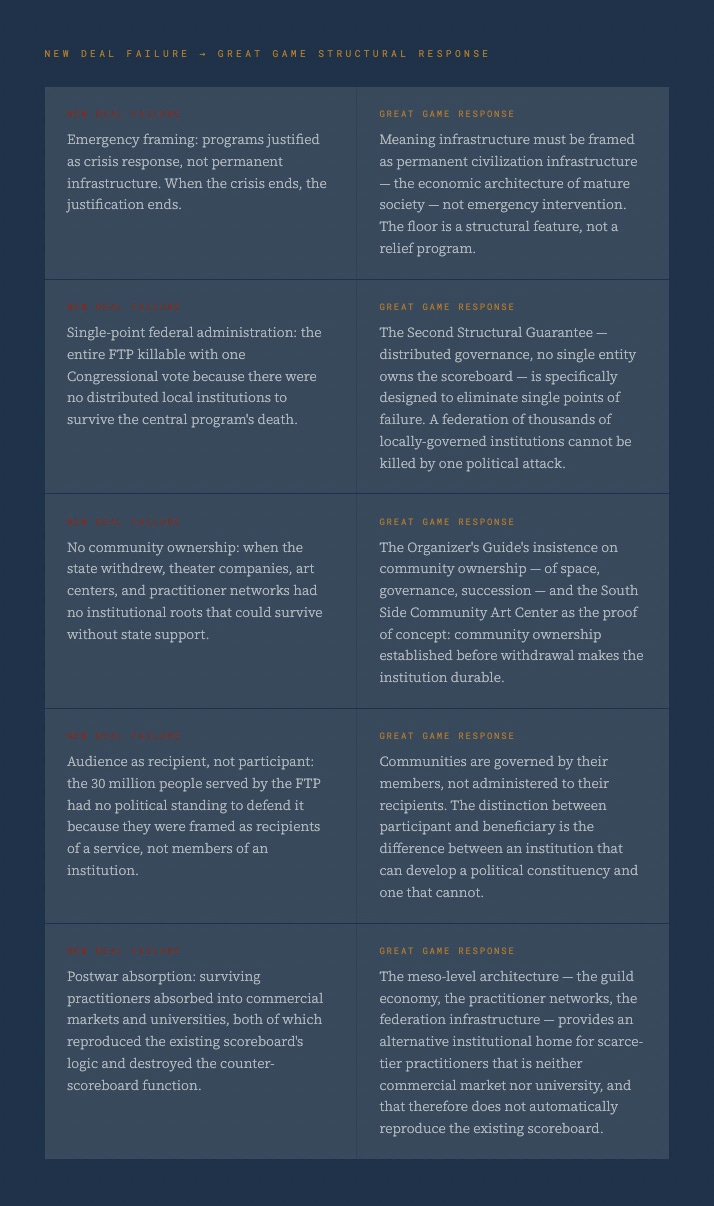
Great Game Lesson → Meaning infrastructure must be framed as permanent civilization infrastructure; as essential as schools, roads, and hospitals; not as emergency response. The floor guarantee and the scarce-tier ecology are not responses to the AGI disruption. They are the economic architecture of a mature civilization.
2. Federal Administration Without Distributed Governance: One Target, One Kill
The Federal Theatre Project was a single national program administered from Washington. There were no community boards, no local legal entities, no distributed governance structures through which specific theaters could claim independent existence. The entire program; 12,000 workers, 1,200 productions, 30 million audience members; existed as a single administrative unit.
This made it killable with a single vote. When Martin Dies’ committee framed the FTP as Communist-influenced, the programs’ defenders in Congress had nothing to point to except the federal program itself. There were no specific community theaters in specific congressional districts with local boards, local donors, and local audiences who could call their representatives and say: this specific theater in this specific place serves this specific community, and you will answer for its destruction. The program’s very scale, which looked like strength, was its structural weakness. Single point of administration equals single point of capture equals single point of failure.
The contrast is instructive. The American folk music tradition, which the FMP documented and which was attacked with equal political ferocity in the early 1950s, survived. It survived not because it was larger or better-funded than the FTP, but because it was distributed; embedded in communities and transmission chains that existed independently of any federal program. You cannot kill a tradition with a Congressional vote. You can kill a program.
Great Game Lesson → The Second Structural Guarantee, no single entity owns the scoreboard, is not a theoretical preference. It is the specific architectural response to this specific failure mode. A federation of thousands of locally-governed communities cannot be killed by a single political attack. The attacks will come. The distributed architecture must be in place before they do.
3. No Community Ownership: When the State Left, Nothing Remained
The most consequential structural failure of the New Deal meaning infrastructure was the absence of any mechanism for the communities it served to own and govern the institutions it created. The theater companies built by the Federal Theatre Project were not owned by their communities. The community art centers created by the FAP were not owned by their neighborhoods. The CCC’s framework of purposeful community was not transmitted to any civilian institution that could continue when the program ended. Everything created existed in the state’s hands, and when the state’s hand opened, everything fell.
The single exception makes the case with almost painful clarity. The South Side Community Art Center in Chicago was founded in 1940 under the FAP. In that same year, before federal funding ended, the Center incorporated independently; developing a local board, local donors, and a legal identity separate from the federal program. When the FAP was defunded, the South Side Community Art Center continued. It is still operating today, 85 years later, the only FAP-era institution still functioning. Its survival was entirely a function of having achieved community ownership before the federal program’s withdrawal.
This is not a lesson about the virtue of community ownership in the abstract. It is a lesson about the specific structural mechanism that makes meaning infrastructure durable: the community must own the infrastructure for the infrastructure to survive the inevitable withdrawal of whatever external support brought it into existence.
Great Game Lesson → The Organizer’s Guide’s insistence on community ownership; of space, governance, and the succession of leadership; is specifically designed to prevent this failure. The question is not whether external support will eventually be withdrawn. It will be. The question is whether the community has developed the institutional roots to survive without it.
⚠ The Political Attack — How It Actually Worked
The Dies Committee’s investigation of the Federal Theatre Project offers a precise case study in how political attacks on meaning infrastructure operate. The attack did not require proof of Communist control of the programs. It required only the credible appearance of political danger, enough to allow hostile Congressmen to vote for defunding without appearing to be attacking art itself.
The mechanics: a committee investigation generates headlines. The headlines make the programs seem controversial. The controversy makes the programs’ defenders unwilling to spend political capital protecting them. The programs are defunded in a vote that most members are glad to cast because it costs them nothing and creates the appearance of vigilance.
The structural point is not that such attacks can be prevented. They cannot. The structural point is that an institution with distributed governance, community ownership, and a permanent constituency has the political architecture to survive them. The Federal Theatre Project had none of these. It had only federal administration and emergency framing, and neither was sufficient when the attack came.
In 1938, a Dies Committee member, questioning Hallie Flanagan about theater practices, asked whether Christopher Marlowe; whom she had quoted in her testimony; was a Communist. The question was absurd. It was also effective. Flanagan’s prepared, articulate answer did not matter. The absurdity of the proceeding was the message. The press coverage made the FTP seem dangerous. The program was defunded nine months later.
V. What Lasted, and Why
Not everything was lost. Several elements of the New Deal meaning infrastructure survived; some in full operation 85 years later, others as archives, others as cultural influences whose original sources are now obscured. The pattern of survival is as instructive as the pattern of failure, because it reveals the specific structural characteristics that make meaning infrastructure durable.
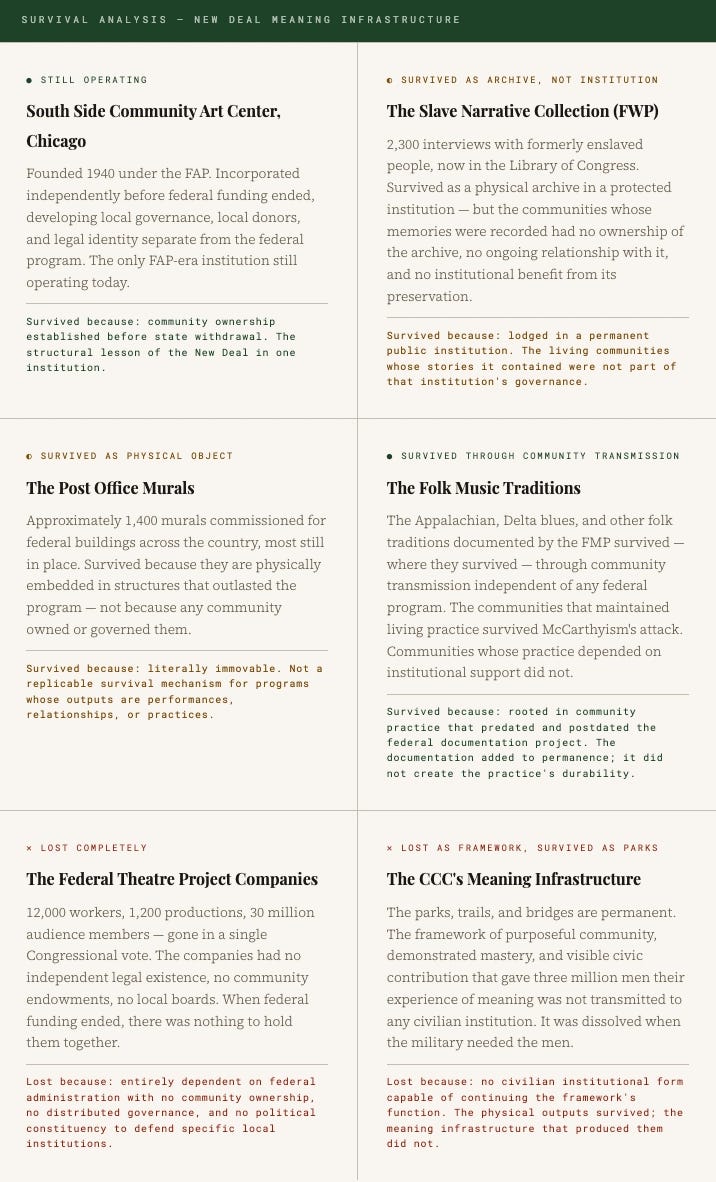
The pattern is clear and consistent. What survived was what was physically embedded in permanent structures, archived in protected institutions, or rooted in community practice that existed independently of the federal programs. What was lost was what existed only in the state’s administrative hands; theater companies, community organizations, practitioner networks; with no independent legal existence, no community ownership, and no political constituency beyond the federal program itself.
The South Side Community Art Center is the proof of concept. It demonstrates that community ownership is sufficient, that an institution which achieves genuine community governance and local financial roots before the withdrawal of external support can survive that withdrawal and thrive for generations afterward. The structural lesson is not complicated. The institutional discipline required to act on it before the crisis comes, rather than after, is where most programs fail.
VI. What the Great Game Must Learn From This
The New Deal failure case does not demonstrate that state-supported meaning infrastructure cannot work. It demonstrates that state-supported meaning infrastructure without specific structural safeguards will fail in predictable ways when subjected to predictable political and economic pressures. The Great Game framework’s Three Structural Guarantees are, in significant part, the direct institutional response to exactly these failure modes; derived here not from philosophical argument but from historical documentation.
The Honest Reckoning
The New Deal case study requires one more acknowledgment that a fully honest historical reckoning demands: the programs were not without their own problems, and those problems are also instructive. The arts programs were racially complicated; pioneering in their inclusion of Black artists and communities by the standards of the 1930s, still deeply shaped by the racial politics of the era. The FTP’s Hallie Flanagan was genuinely committed to reaching Black audiences; she was also operating within a federal government that maintained Jim Crow in other programs and in the country itself. The CCC was racially segregated until 1942. The oral history projects documented the voices of formerly enslaved people with genuine care; they also operated in a context in which those voices had no institutional power over how their stories would be used.
These are not peripheral criticisms. They are examples of the First Structural Guarantee’s application: the floor must be genuinely universal, or it is not a floor. A meaning infrastructure that reaches some communities and excludes others by race, class, or geography is not an implementation of the framework; it is a stratified version that reproduces the existing scoreboard’s exclusions while using the framework’s language. The programs’ racial limitations were not incidental features. They were expressions of the same political constraints that ultimately killed the programs: the dependency on a state that could not fully commit to the framework’s universality without threatening the political coalition on which it depended.
The Great Game framework’s insistence on genuine universality; the floor that is real for everyone, not rhetorically universal and practically stratified; is the direct institutional response to this failure too. A framework that cannot be genuinely universal cannot survive its own internal contradictions, however powerful the external attack that eventually kills it.
It Was Real. And Then It Wasn’t.
The New Deal meaning infrastructure was real. The young man from the Bronx who arrived at a CCC camp in 1936 and learned, for the first time, that his hands could build something permanent; he was real. The Black woman in a small Southern town who walked into a Federal Art Project community center in 1937 and discovered that drawing was something she could do, that her vision of the world was worth expressing; she was real. The audience in Harlem who saw the “Voodoo” Macbeth and understood, perhaps for the first time in their theatergoing experience, that the stage could hold their world; they were real. These were not policy outcomes. They were human lives changed by the experience of being genuinely seen, genuinely supported, genuinely valued in their specifically human capacities.
And then it was gone. Not slowly, not gradually, not through the natural exhaustion of an idea that had run its course. Quickly. Specifically. Through political attack, through the removal of funding, through the absorption of practitioners into institutions that did not honor what they had been doing. The world they had been part of, the world that had briefly made genuine human excellence publicly visible and economically viable, ceased to exist within a decade of its construction.
The Great Game series has argued, from multiple directions, that humanity must deliberately build meaning infrastructure for the post-AGI world. The New Deal case is not an argument against that project. It is the most detailed available evidence for what the structural requirements of that project actually are. Emergency framing will not hold. Federal administration without distributed governance will not hold. Programs without community ownership will not hold. Universal commitments that are practically stratified will not hold.
What the New Deal built was worth building. What the New Deal failed to protect is what the Great Game framework must protect from the beginning; not because the political attacks and the market pressures and the ideological shifts will not come, but because they will come, and the framework must be designed to survive them before they arrive, not reformed to survive them after they have already succeeded.
Note on Method: This case study applies the Great Game series’ analytical framework; the Three Structural Guarantees, the capture pattern, the community ownership requirement; retrospectively to a historical episode that predates the framework by ninety years. The historical facts are documented; the interpretive framework is the series’. The South Side Community Art Center remains in operation and is the most direct living evidence for the case study’s central structural lesson.
Primary Sources:
Hopkins, H. — Spending to Save (1936)
Flanagan, H. — Arena: The History of the Federal Theatre (1940)
Mangione, J. — The Dream and the Deal: The Federal Writers’ Project (1972)
Bindas, K.J. — All of This Music Belongs to the Nation: The WPA’s Federal Music Project (1995)
Salmond, J.A. — The Civilian Conservation Corps, 1933–1942 (1967)
Historical Analysis:
Leuchtenburg, W. — Franklin D. Roosevelt and the New Deal (1963)
McDonald, W. — Federal Relief Administration and the Arts (1969)
Bustard, B. — A New Deal for the Arts (1997)
Bold, C. — The WPA Guides: Mapping America (1999)
Hirsch, J. — Portrait of America: A Cultural History of the Federal Writers’ Project (2003)