


Every article in this series treats the universal material floor as a precondition, not an aspiration. This one asks the question the rest of the series has been able to avoid: what does the Great Game actually require of a person, a community, and a civilization if the floor never materializes; if AGI delivers the displacement without the dividend? The honest answer is not that the framework still basically works. It is more specific, more limited, and more useful than that.
The Material Foundation article named the default trajectory plainly: in the absence of deliberate institutional design, the gains from AGI productivity concentrate in the hands of whoever owns the systems, exactly as every previous productivity revolution’s gains have concentrated by default. The Political Economy article named the transition window as genuinely narrow and already closing. Both articles then proceeded, as the rest of the series does, on the working assumption that the floor gets built; that the institutional response arrives in time. This article asks what follows if it does not.
The honest answer is not that the Great Game survives intact and merely operates “at smaller scale” or “for fewer people.” The series has been explicit and repeated on this point: the floor is not an add-on to the vision, it is the precondition without which the vision becomes, in its own stated terms, a luxury good available only to the already comfortable; the exact stratification of meaning the framework exists to prevent. Taking that claim seriously means taking seriously that a Great Game without a floor is not a smaller Great Game. It is something else: a resistance practice, not a civilizational architecture.
This article develops that distinction in full; what specifically breaks when the floor fails to arrive, what fragments of the framework survive anyway and why, what the historical record says about meaning-cultivation under conditions of involuntary scarcity, and what the absence of any guarantee that the floor will arrive implies about what should be built first, while the window is still open, rather than after it has closed.
Covered Here:
I. Naming the live possibility without flinching from it
II. What specifically breaks; the floor as load-bearing wall, not amenity
III. What survives anyway, and under what name
IV. The historical record of meaning under involuntary scarcity
V. The new Capture Pattern risk this scenario creates
VI. What changes now, while the fork is still open
VII. An honest closing
I. This Is Not a Thought Experiment
Every serious article in this series has named the same fork without dwelling on it. The Material Foundation called it “the default trajectory”: AGI productivity gains, absent deliberate institutional design, concentrate in the hands of whoever owns the systems that generate them; exactly as the gains from the agricultural and industrial revolutions concentrated, in both cases for decades before any institutional correction arrived, and in many places never. The Political Economy article called the transition window “genuinely narrow,” noted that AGI ownership concentration, data monopolies, and the political influence of AGI-owning firms over the regulatory response are already underway rather than speculative, and that the institutions required to redistribute the surplus are “being designed while those gains are being accumulated”, which gives the people accumulating them enormous leverage over how the design turns out.
This article takes the next step the rest of the series has consistently deferred: it asks what follows if that leverage wins. Not as a hedge, not as a brief caveat before returning to the optimistic case, but as the live possibility it actually is. The honest base rate, drawn from every previous general-purpose technology shift in recorded economic history, favors this branch, not its alternative. Enclosure won before parliamentary correction. Industrial concentration won for the better part of a century before labor law, antitrust enforcement, and the welfare state arrived; and arrived, in most cases, only after sustained organizing, several genuine catastrophes, and considerable loss of life. There is no historical precedent for a transformative production technology whose gains were broadly redistributed before a long period of concentrated extraction. The pattern is not pessimism. It is simply what the record shows.
To write a meaning framework that only works if the optimistic branch occurs is to write a framework for people who will not need it. The people who need a Great Game most urgently are the ones standing in the branch where the floor did not arrive in time.
Naming this clearly is not a betrayal of the series’ hope. It is the Third Structural Guarantee applied to the series itself. A framework that has built its credibility on insisting that visions must be honest about their own failure modes cannot exempt its own central economic premise from that same honesty. If the floor is the precondition for everything else, then a framework serious about its own claims has to ask, in detail and without flinching, what it is actually offering to the people for whom the precondition fails.
II. The Floor Was Never Decoration
It is worth being precise about why the floor’s absence is not a matter of degree; why “the Great Game without the floor” is not simply “the Great Game, but harder to access.” The series has built three claims directly on top of the floor’s presence, and each one fails in a specific, traceable way when the floor is absent rather than merely incomplete.
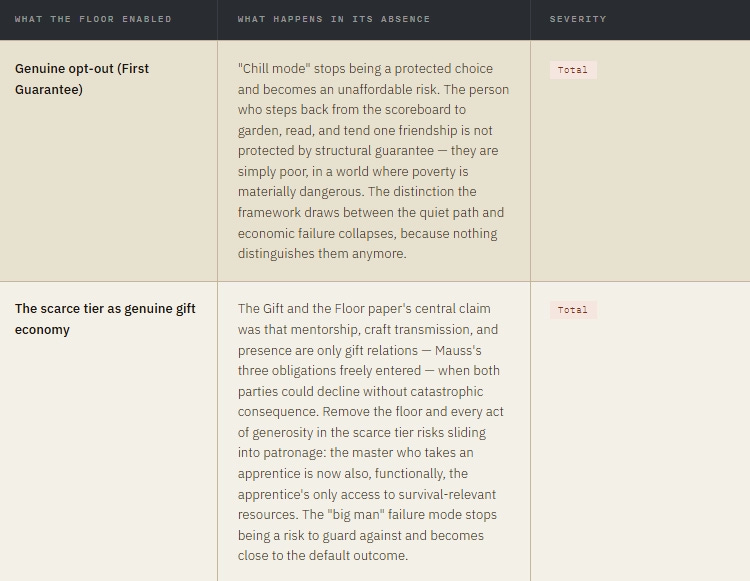
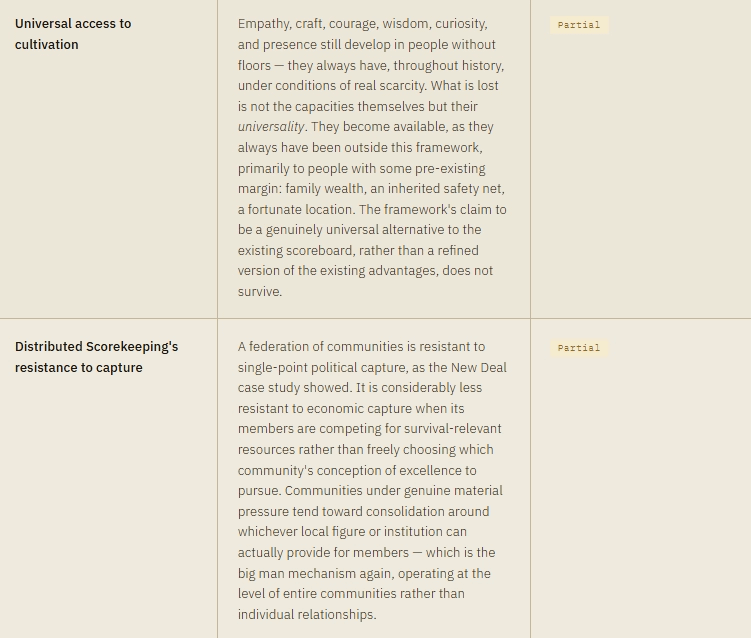
The pattern across all four rows is the same: the floor’s function was never to make participation pleasant. It was to remove the coercive background pressure that converts every other mechanism in the framework; opt-out, gift, cultivation, distributed governance; from what it claims to be into a more comfortable-looking version of the existing scoreboard’s coercion. Without the floor, the Great Game does not stop existing. It stops being able to claim the thing that distinguishes it from every previous meaning system that promised liberation and delivered obligation.
The Claim This Article Will Not Make
It would be easy, and dishonest, to write a softer version of this section; one that argues the framework “still provides most of its value” without the floor, or that the quiet path is “still meaningfully available, just harder to access.” The series’ own prior commitments rule this out. The Material Foundation called the floor “the economic precondition without which the rest of the cycle cannot turn.” On the Deliberate Cultivation called a floor-less version of the framework “a luxury for the comfortable, wearing the clothing of a universal vision.” Those were correct claims when written. They remain correct here. This article does not soften them. It asks what is left when they are taken at full strength and the precondition genuinely fails.
III. Not the Civilization. The Remnant.
If the floor fails to arrive, the Great Game as a civilizational architecture; the thing the Political Economy and Middle Architecture articles describe, with its nested institutions from neighborhood to nation to supranational commons; does not get built, or gets built in such a stratified and partial form that it functions mainly as cultural decoration for people who do not need it. That has to be said plainly and not walked back. But something does survive, because the framework’s own historical and biological grounding articles already established that the capacities it describes are not contingent on the institutional architecture that the series proposes. They are older than the proposal, and they have always found ways to persist without it.
The honest name for what survives is not “the Great Game, informally.” It is something more specific: a resistance practice; the deliberate cultivation of the same six capacities, pursued by individuals and small groups without the civilizational scaffolding, as an act of refusal against a scoreboard that has not merely failed to honor what they value but has actively organized a world in which honoring it is materially costly. This is a different thing from the vision the rest of the series describes, and the difference matters enormously for anyone trying to act on the framework in the branch where the floor does not come.
1. Craft persists because it is also a hedge
Embodied skill, the framework’s “craft” capacity, has a property that makes it disproportionately durable under conditions of involuntary scarcity: it produces something exchangeable even when the exchange is informal, local, and outside any institutional recognition. The carpenter, the cook, the mechanic, the person who can actually fix things with their hands, retains economic relevance precisely because their knowledge lives in procedural memory that AGI’s abundant tier has not yet, and may never, fully displace at the local and improvisational scale. Craft is the capacity most likely to survive the floor’s absence, not because it is spiritually superior to the others, but because it is the one capacity in the index that does double duty as a literal survival strategy.
2. Mutual aid networks, not federated communities
The Organizer’s Guide describes communities of 12 to 150 people building witness infrastructure, celebration logic, and a floor guarantee within their own boundaries. Without an external floor, this becomes something with a long and specific history: the mutual aid network, in which a small group pools risk informally because no one outside the group will. This is not the same institution. A mutual aid network’s first obligation is survival, not cultivation; and the cultivation that does happen within it happens as a byproduct of shared hardship rather than as the network’s primary design intention. It is a real and valuable form of human organization. It is also, by the series’ own standards, exactly what the floor was supposed to make unnecessary as the primary mechanism of dignity.
3. Wisdom and presence survive in whoever has margin
The Biological Case and Structure of Experience articles established that wisdom requires the specific autobiographical pattern of having been confidently wrong and lived through the consequences, and that presence requires a being with genuine optionality to be elsewhere. Both remain available to anyone with a life, regardless of economic conditions. What changes without the floor is not whether these capacities can develop, but who has the margin; the literal, finite hours not consumed by survival labor; to develop them with any consistency. The capacities do not become impossible. They become, once again, the province of whoever has slack in their life; which, absent the floor, reliably correlates with whoever already has resources, restoring exactly the stratification the framework was designed to dissolve.
4. The vocabulary survives, and the vocabulary is not nothing
One thing the floor’s absence cannot take away is the naming itself; the fact that a person without institutional support can still recognize their own life, accurately, in the language of the skill tree rather than the language of the existing scoreboard. The Organizer’s Guide noted that the work of a counter-scoreboard community is “not to convince anyone to adopt new values” but to make values people already hold safe to act on publicly. Even where the floor never arrives, the private version of that work remains possible: a person can still measure their own life by craft, courage, wisdom, empathy, curiosity, and presence rather than by net worth and credential, even when no community around them is doing the same. This is a smaller victory than the framework hopes for. It is not a trivial one. The Stoics built an entire serious philosophical practice on a version of exactly this (see Section IV).
What this list does not include is as important as what it does: there is no item here that restores universal access, resists capture at scale, or removes the coercive background pressure that the floor exists to remove. The remnant is real. It is also, by definition, a remnant; available disproportionately to those who already have some margin, vulnerable to exactly the capture patterns the Three Structural Guarantees were built to prevent, and incapable of being the universal civilizational architecture the rest of the series describes. Calling it anything more than that would be the kind of dishonesty the framework was designed to resist in everyone else.
IV. Meaning Cultivated Under Duress
The series has, until now, drawn its historical evidence from periods of relative institutional stability or institutional construction; the New Deal’s brief window of state-supported meaning infrastructure, the long arc of Greek, Confucian, and Abrahamic tradition-building. There is a different historical record worth examining for this article’s purposes: instances in which serious traditions of human cultivation were maintained specifically without a material floor, under conditions of genuine and involuntary scarcity, sometimes for centuries. What that record shows is neither despair nor false comfort. It shows a consistent and specific set of constraints.
Stoicism Under Empire, Cultivation Without a Floor
The Stoic tradition is frequently cited in this series as philosophical lineage, and it is worth examining directly as the closest historical precedent for cultivation without institutional floor support. Epictetus was born enslaved. His philosophy of focusing exclusively on what is “up to us”; judgment, will, response; while treating everything else, including material circumstance, as fundamentally not within one’s control, is not merely a metaphysical position. It is a coping architecture specifically engineered for people who have no floor and no realistic prospect of one. It produced genuine wisdom, genuine courage, and a tradition that has lasted two thousand years.
It also, and this is the part the series must not omit, counsels something close to acceptance of unjust material conditions as the price of inner cultivation. A philosophy this well-adapted to surviving without a floor is also, structurally, a philosophy that makes its practitioners less likely to organize for one. The Stoic remnant is real and admirable. It is not a substitute for the floor. It is what cultivation looks like when the floor is not coming, and it comes with a specific cost: a tendency to relocate the entire struggle inward, at exactly the moment when the outward struggle for redistribution most needs participants.
A second and related case is the Black church tradition in the United States under slavery and Jim Crow; a sustained, multi-generational practice of cultivating dignity, courage, wisdom, and genuine community in conditions of total material deprivation and active state violence, using almost none of the institutional supports this series treats as preconditions. The tradition produced figures of extraordinary moral depth. It also operated for centuries before any floor arrived, and the floor that eventually arrived; incomplete and contested as it remains; arrived because the tradition’s cultivation of courage was deployed, deliberately and at enormous cost, toward organizing and confrontation, not because cultivation alone changed the material conditions. The lesson is not that meaning-cultivation under duress is impossible. It plainly is not. The lesson is that historically, it has not by itself produced the floor. The floor, when it has arrived at all, has arrived through political struggle that the cultivation supported and sustained, not through the cultivation substituting for it.
No tradition in the historical record shows cultivation alone producing the material conditions it requires to become universal. Every case shows cultivation sustaining the people who then fought for those conditions through other means.
This is the single most load-bearing historical finding for this article’s argument, because it answers the practical question a person actually facing this branch will ask: if the floor does not come, should I devote myself to cultivation, or to fighting for the floor? The historical record’s answer is that this is a false choice, and that every tradition which treated it as a real choice and picked cultivation exclusively ended up, like later Stoicism under Rome, providing dignified inner resources to people whose outer conditions never improved. The traditions that mattered most combined both; cultivation as what sustains the people who do the second, harder work of building the institutions that the first generation will never get to use.
V. When the Game Becomes an Anesthetic
There is a specific and serious danger in this scenario that the Capture Pattern analysis elsewhere in the series names in other contexts but that deserves direct statement here: a Great Game without a floor is exceptionally well-suited to being captured not by a hostile institution seeking to control it, but by the existing scoreboard’s beneficiaries finding it useful, exactly as it is, as a release valve.
Consider the mechanism precisely. A population experiencing AGI-driven displacement without redistribution is a population with a serious legitimacy problem on its hands, from the point of view of whoever owns the systems generating the displacement. A philosophy that tells this population to find dignity in craft, presence, and community despite their circumstances; without simultaneously and loudly insisting that those circumstances are a policy failure requiring urgent correction; is not a threat to the people who benefit from the current distribution. It is a gift to them. It is, in fact, almost exactly what Section IV identified as the cost of later Stoicism: a sophisticated, genuinely meaningful, and ultimately demobilizing inner architecture that makes unjust outward conditions more bearable without making them less unjust.
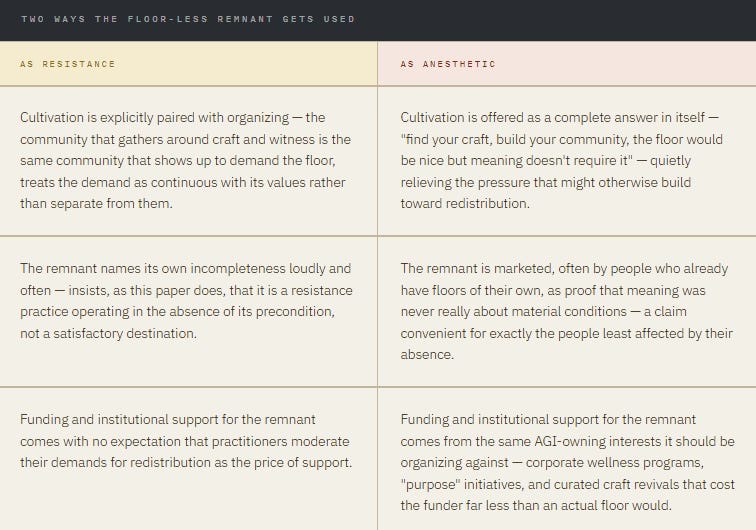
The right-hand column is not a hypothetical. The basic mechanism; well-resourced institutions promoting personal meaning-cultivation as a substitute for structural change, often using language nearly identical to this series’ own; has a documented history under other names: corporate mindfulness programs introduced during periods of stagnant wages and intensifying surveillance, “hustle culture’s” inverse twin in “slow living” content marketed to precisely the demographic that can least afford to slow down, gratitude-practice literature that flourished in step with declining real wages. None of these are accusations against any specific actor. They are a pattern, and the pattern is exactly the Capture Pattern the series has named throughout: a genuinely valuable framework, adopted by an entity whose interests are not the framework’s original interests, redirected toward outcomes the framework’s authors did not intend and would not endorse.
The Test for Which Branch You Are In
Any person, organization, or institution promoting the Great Game’s vocabulary; craft, presence, wisdom, the quiet path; in a context where the floor has not been secured, should be asked a direct question: does this organization’s continued existence depend, even partly, on the floor remaining unbuilt? An employer offering “purpose” programming instead of wages has an answer to that question, and the answer disqualifies the program from being a good-faith application of this framework, regardless of how sincerely any individual involved believes in it. The test is not about motive. It is about structural position, which is the only thing the Capture Pattern has ever actually tracked.
VI. Designing for the Branch While It Is Still a Branch
The point of taking the pessimistic branch seriously is not to prepare a consolation for when it arrives. It is to change what gets built now, while the fork is still genuinely open, because the branches require different and in some cases opposite immediate priorities. A strategy correctly optimized for “the floor will probably arrive in time” looks different from a strategy correctly optimized for “the floor’s arrival is genuinely uncertain and the uncertainty itself is the central fact to design around.”
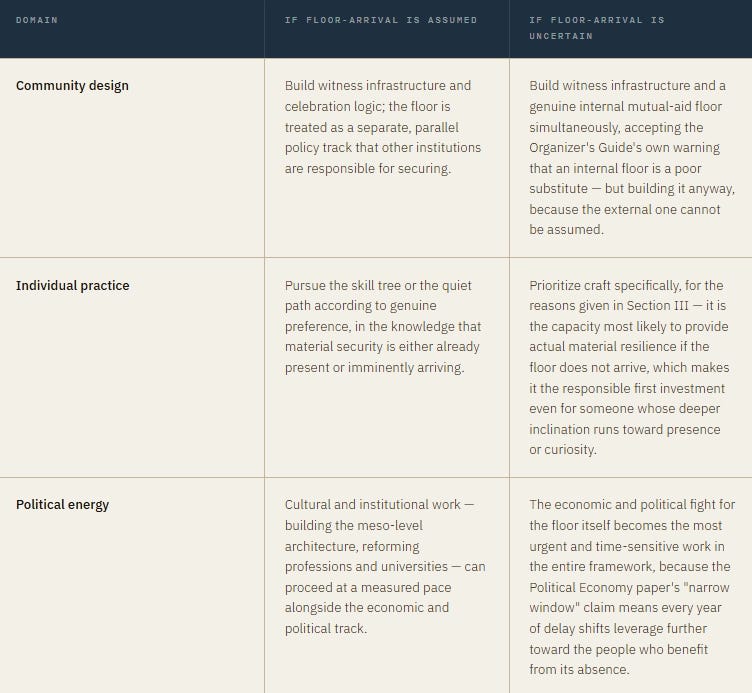
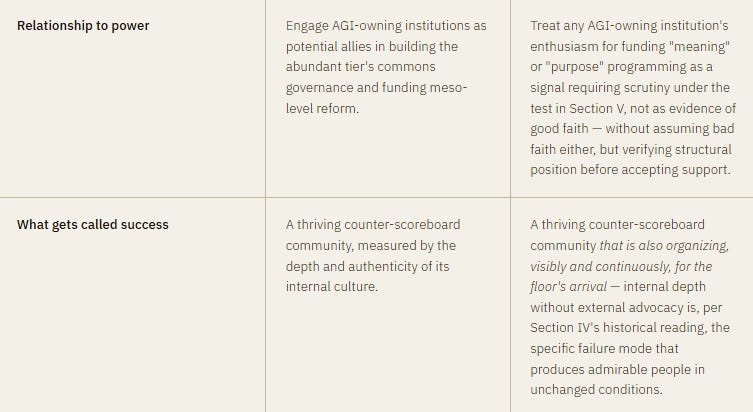
The single highest-leverage implication of this entire article is the one in the third row, and it is worth stating without the table’s compression: if there is genuine uncertainty about whether the floor arrives, the floor’s arrival is not a parallel track to be pursued at a comfortable pace while the more appealing cultural work proceeds. It is the most urgent item on the entire agenda, more urgent than community design, more urgent than the meso-level institutional reform the Middle Architecture article describes, more urgent, even, than this series’ own continued intellectual development; because every other element of the framework is conditional on it in the specific and total way Section II describes, and because the window for building it, on the Political Economy article’s own analysis, is the one resource in this entire undertaking that cannot be recovered once spent.
A community that has built a beautiful internal culture and has not also fought for the floor has optimized for the wrong branch. It has built something that works only in the world where it was not, in the end, strictly necessary.
VII. Not a Consolation. A Set of Instructions for the Worse Branch.
This article has not argued that the Great Game is fine without the floor. It has argued the opposite, in more specific terms than the rest of the series has needed to use, because the rest of the series has had the luxury of writing primarily about the branch where the precondition holds. Without the floor, the framework does not fail completely; empathy, craft, courage, wisdom, curiosity, and presence remain real, developable, and worth pursuing, exactly as they were before any of this series existed, because they are older than the series and do not depend on it. But the civilization-scale claim; that this can be a genuinely universal alternative to the existing scoreboard, available to everyone rather than to whoever already has margin; does not survive the floor’s absence. It cannot. The series has been too honest about why the floor matters to pretend otherwise now.
What does survive is real enough to be worth naming precisely rather than either inflating or dismissing: a remnant practice, historically attested, capable of sustaining real human dignity under real and unjust conditions, vulnerable to a specific and serious capture risk that turns it into an anesthetic for the very conditions it should be helping people resist, and incomplete in a way that no amount of community-building or individual cultivation can fully repair. The remnant is worth practicing. It is not worth mistaking for the destination.
The practical instruction this article leaves is simple to state and hard to act on with the urgency it actually requires: build the floor first, or build it simultaneously with everything else, and treat every hour spent on cultural and institutional refinement without a corresponding hour spent on the material fight as an hour spent preparing for the branch that may not arrive. This is not a comfortable instruction for a series that has spent most of its length on philosophy, history, biology, and institutional design. It is, on the evidence this article has assembled, the correct one.
If the floor comes, this article was unnecessary, and that is the best outcome available. If it does not, this article was the most important one in the series, and arrived too late to be anything more than a description of what was already being asked of you. Build the floor. Build it now. Build everything else around that fact.
A Note on Method: This article is deliberately the least optimistic document in the series. It does not propose new structural guarantees or institutional mechanisms; its purpose is diagnostic and strategic, not architectural. Where it draws historical analogy, the analogy is offered to establish a pattern, not to claim equivalence between historical conditions and any specific present circumstance.
Series Context: This article directly confronts the “default trajectory” and “concentrated private ownership” failure modes named in “The Material Foundation“ and the “narrow window” analysis of “The Political Economy of the Great Game“. The Three Structural Guarantees referenced throughout are defined in “On the Deliberate Cultivation of Human Excellence.” The Capture Pattern mechanism is applied here to the framework’s own potential misuse, consistent with its use elsewhere in the series.
Historical Sources:
Epictetus — Discourses
Polanyi, K. — The Great Transformation (1944)
Higginbotham, E. — Righteous Discontent: The Women’s Movement in the Black Baptist Church (1993)
Cone, J. — The Cross and the Lynching Tree (2011)
Standing, G. — The Precariat (2011)
Thompson, E.P. — The Making of the English Working Class (1963)