


The Great Game framework draws on the Word of God as evidence while refusing its authority. That maneuver has a name in philosophy. This article examines whether the framework can survive it, and what it owes to those for whom the convergence it celebrates is not a coincidence but a sign.
“The designed nature of the framework must always be openly acknowledged. Its values are chosen. Its metrics are constructed.”
The Great Game — Third Structural Guarantee
“God became human so that humans might become God.”
Athanasius of Alexandria — On the Incarnation, c. 318 CE
I. Using the Revelation Without the Revealer
The Great Game series makes an unusual move in its chapter on historical foundations. It gathers three of the world’s most serious intellectual traditions; Greek philosophy, Confucian ethics, and the Abrahamic religions; and presents their convergence as evidence for the framework’s central claim: that the deliberate cultivation of empathy, craft, courage, wisdom, curiosity, and presence constitutes the proper occupation of a human life. The convergence, the argument runs, is too consistent across too great a distance to be coincidental. Three different civilizations, no shared premises, the same structural answer. That consistency is what the framework calls a “discovered truth about human nature.”
The argument is compelling. It is also philosophically uncomfortable in a specific way that the series acknowledges only briefly, and then sidesteps.
Here is the problem. The Abrahamic traditions; Judaism, Christianity, and Islam; do not present their conclusions about human flourishing as the output of independent philosophical inquiry that happened to align with other traditions. They present them as revealed. The mitzvot are not a social contract arrived at by committee. Ihsan is not an optimization discovered by ancient management consultants. Theosis is not a self-improvement protocol that early Christians happened to find effective. These frameworks claim that the truth about what human beings are for comes from outside human beings; from God, from revelation, from the structure of a universe that was made with a purpose already written into it.
The Great Game framework, by its own Third Structural Guarantee, makes the opposite claim: its values are chosen, its metrics are constructed, its design is human and auditable. It is not revealed. It is built.
You cannot cite a revelation as evidence for a humanly constructed framework without implicitly asking: if the revelation is true, why isn’t the revelation the framework?
This is the maneuver that requires examination. The framework uses the Abrahamic traditions as three of its five witnesses to a truth, and then declines the theological grounding that those traditions say is the only reason the truth is true. That is not a logical contradiction. But it is a philosophical debt that has not been paid, and it matters more than the series acknowledges.
II. The Same Evidence, Read Differently
The convergence argument can be read in at least two ways, and which reading is correct depends on a prior question the framework refuses to adjudicate.
Reading one, which is the framework’s reading, is this: when three traditions with no common metaphysics, no shared culture, and no mutual knowledge arrive at the same structural conclusions about human flourishing, that convergence is evidence of something real about human nature. The traditions are witnesses. The truth they are pointing at is not divine. It is anthropological. Human beings are the kind of creatures who flourish through empathy, craft, courage, and presence; and the traditions independently discovered this the same way anyone discovers a truth: by careful observation of what actually works.
Reading two, which is the theist’s reading, is this: when three traditions with no common metaphysics arrive at the same structural conclusions about human flourishing, that convergence is evidence of a common source. The traditions are not independently discovering a truth. They are independently receiving a revelation, through different channels, in different vocabularies, pointing at the same God. The convergence is not coincidence and it is not anthropology. It is the signature of a Creator whose image is written into human nature so deeply that even those who do not know His name find their way back to the same description of what it means to bear it.
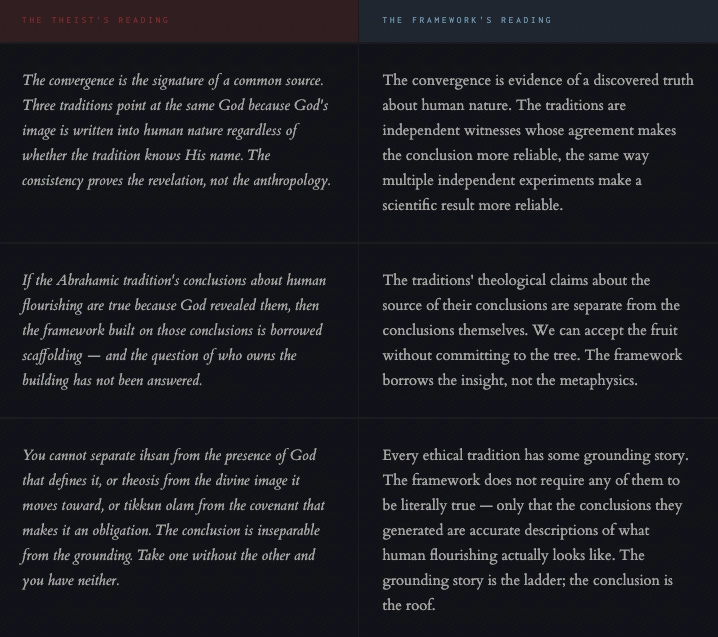
Neither reading is obviously wrong. Both are coherent. The framework’s reading is the more epistemically humble one in some respects; it makes no claims about ultimate reality, only about what consistent human observation has found. The theist’s reading is the more coherent one in a different respect; it explains why the convergence happened, rather than merely noting that it did.
The framework’s silence on which reading is correct is not a neutral choice. It is a choice to build on the evidence while declining the explanation. That is a defensible move. But it needs to be made consciously, with its costs acknowledged; not simply left as an unmarked gap in the architecture.
III. You Cannot Separate the Fruit from the Tree
The framework’s implicit answer to this tension is what philosophers call the genetic fallacy defense: the origin of a belief does not determine its truth. The fact that Confucius arrived at the importance of empathy through a specific cultural and philosophical tradition does not mean empathy is only important within that tradition. The conclusion can travel without the scaffolding.
This is philosophically sound as far as it goes. But the Abrahamic traditions, at their most serious, raise a more precise objection that this defense does not fully answer.
Consider the three specific concepts the series cites as Abrahamic contributions to the convergence: the Jewish tikkun olam, the Christian theosis, and the Islamic ihsan. Each of these is presented in the series as a cultural expression of the same structural insight; that human beings are called to become more fully what they are capable of being, in community, through practice, oriented toward something beyond themselves.
The theist’s objection is that this summary, while not wrong, strips each concept of the content that makes it what it is.
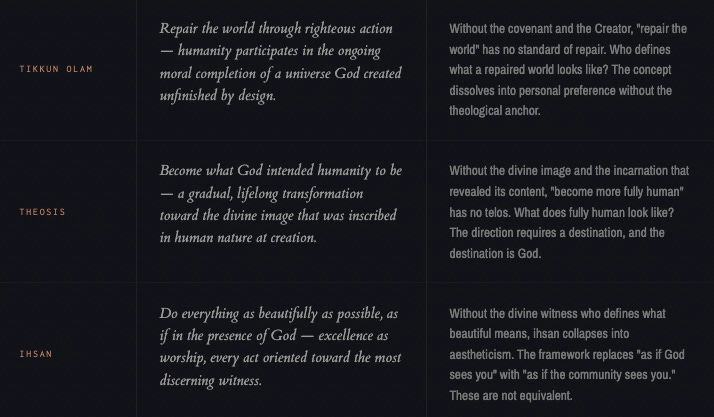
The objection, stated plainly: each of these concepts functions by orienting human action toward something outside human construction; toward God, toward the divine image, toward the presence of a witness who is not a social consensus. When the framework abstracts the concept from that orientation, it does not preserve the concept. It produces a secular approximation that resembles the original the way a photograph resembles a person. The form is captured. The life is not.
The framework’s response, that the conclusions can travel without the metaphysics, is only convincing if the metaphysics is in fact separable from the conclusion. The theist’s claim is precisely that it is not. And this is not a point that can be settled from the outside.
IV. The Shrug It Calls Transparency
To the series’ considerable credit, it does not pretend this gap does not exist. The Third Structural Guarantee; the insistence on visible construction and permanent auditability; is, among other things, an acknowledgment that the framework cannot do what the traditions it draws on claimed to do. They claimed to reveal. It only claims to build. The transparency is honest about this difference.
But transparency is not the same as resolution. Naming a gap is not the same as filling it. And the specific gap here, the question of what grounds the framework’s conclusions if not human construction, is one that the series acknowledges obliquely at best.
The Gap, Named Directly
The Great Game framework concludes that empathy, craft, courage, wisdom, curiosity, and presence are the proper occupations of a human life. It arrives at this conclusion through the convergence argument, three independent traditions pointing at the same answer. It presents this convergence as evidence that the answer is genuinely true about human nature, not merely culturally preferred.
But “genuinely true about human nature” is a claim about something. It implies that human nature has a structure that can be correctly or incorrectly described, that there is a fact of the matter about what human beings are for. The framework wants the benefit of that claim without the metaphysical commitment that ordinarily underwrites it.
If human nature has no author, what makes any description of it correct rather than merely popular? The convergence shows that three traditions agreed. It does not, by itself, show that they were right. Agreement at scale is evidence, but it is not proof. History contains many things that three civilizations agreed on that were wrong.
The framework handles this by treating the convergence as sufficient; as the best evidence available, good enough to build on even without ultimate grounding. This is a defensible epistemological position. It is also, honestly stated, a wager rather than a demonstration. The framework is betting that the convergence tracks something real. It cannot prove it does.
Religious traditions do not face this problem in the same form. They do not need the convergence to be sufficient evidence, because the convergence is not their primary claim. Their primary claim is revelation; and if revelation is real, the convergence is explicable, the conclusions are grounded, and the question of what makes them true has a direct answer. The framework’s transparency is the honest acknowledgment that it does not have a direct answer. It has an inference from evidence, and the evidence is good but not conclusive.
This is not a fatal flaw. Most serious ethical systems, including most secular ones, operate on similarly ungrounded foundations; treating the convergence of considered moral intuitions as sufficient reason to build, without resolving the metaethical question of what makes moral claims true. The Great Game framework is in good company. But the company is not religious tradition. It is secular moral philosophy, with all of secular moral philosophy’s genuine strengths and genuine limitations.
V. Neither False. Neither Complete. Both Required.
The question that opened this inquiry — does the Great Game’s approach imply that the Word of God has false legitimacy, or that the framework does? — now has its answer. Neither. But the answer requires precision.
The Word of God does not lose legitimacy because a secular framework arrives at similar conclusions through different means. If anything, the existence of the framework is evidence that the traditions were tracking something real. A framework built entirely on secular grounds that independently rediscovers what revelation pointed at does not refute revelation. If the theist is right, it confirms it.
The Great Game framework does not lose legitimacy because it cannot match the depth of grounding that religious traditions offer. Most serious ethical frameworks cannot. The framework is honest about its limits, which is more than can be said for frameworks that hide them. Its conclusions are defensible, its evidence is substantial, and its structural safeguards are among the most carefully designed in the literature on meaning systems.
What both frameworks lose is the comfort of thinking the other is simply wrong.
The theist who engages seriously with the Great Game framework cannot dismiss it as mere humanism without reckoning with the fact that it arrived, through careful reasoning, at the same practical conclusions that revelation reached through a different route. If ihsan is genuinely about doing everything beautifully as if in the presence of God, and the framework’s “presence” skill produces recognizably similar human behavior in people who have never heard of God; the theist must ask what that means. It may mean that God’s image in humanity is more stubborn than any theology gives it credit for. It may mean something else entirely. But it demands engagement, not dismissal.
The secular thinker who builds on the Great Game framework cannot use it to avoid the grounding question. The framework’s own Third Structural Guarantee demands that its construction be auditable. And the honest audit reveals that the foundation underneath the convergence argument is not solid ground but a suspension bridge; held up by the weight of evidence on either side, crossing a gap that has not been filled. That is enough to walk on. It is not enough to stop asking what is underneath.
The framework says: we built this, and the building is auditable. The tradition says: we received this, and the receipt is the point. These are not competing descriptions of the same thing. They are descriptions of different things that happen to produce remarkably similar buildings.
What the encounter between these two positions produces, if it is honest on both sides, is not a winner. It is a more precise understanding of what each is actually claiming. The religious tradition is not simply providing a grounding story for conclusions the framework could have reached anyway. It is claiming that the conclusions have the character they have; obligatory, universal, genuinely true; because of their source, not just their content. Strip the source and you change the conclusions, even if the words stay the same.
The framework is not simply borrowing religious wisdom for secular purposes. It is offering an account of how those same practical conclusions can be approached, built into institutions, and acted on by people who cannot in good conscience claim revelation as their authority; and who believe that genuine pluralism requires a framework that does not depend on any single tradition’s theological commitments being correct.
Both claims are serious. Both deserve better than the conversation currently offers them, which is mostly mutual incomprehension. The theist tends to dismiss the framework as warmed-over virtue ethics without the God who makes virtue matter. The secularist tends to dismiss the theological grounding as unnecessary scaffolding around conclusions that can stand on their own. Neither dismissal is adequate to what the other is actually saying.
What the Framework Owes
There is one specific debt the framework has not paid, and naming it is not a criticism but a specification of work still to be done. The Great Game series has made its case to secular readers with great care. It has built its structural guarantees, named its failure modes, and documented its intellectual lineage. What it has not done, and what this inquiry requires, is engage directly and seriously with what a religious person loses by adopting the framework’s approach rather than their tradition’s.
The loss is real. A person who practices ihsan as an act of worship, done in the genuine presence of God, is doing something categorically different from a person who practices presence as a skill on a human capacity index. The framework can produce similar behavior. It cannot produce the same meaning. And for the person for whom the meaning is the point; for whom the practice of presence is valuable precisely because it is a form of obedience to a God who sees; the framework’s offer is, however generously intended, a reduction.
The framework’s answer; that it is designed for those who cannot claim revelation as their authority, and that it does not seek to replace traditions for those who have them; is the right answer. But it requires saying clearly: the framework is not the tradition. It is what the tradition’s insights look like when they travel across the border of metaphysical commitment into territory where that commitment cannot be assumed. Something is preserved in that journey. Something is also left behind.
Naming what is left behind is not a concession. It is an act of intellectual honesty that the framework’s own Third Structural Guarantee demands.
VI. The Gap Is the Most Honest Part
The Great Game framework and the Word of God are not competitors in the way the original question implied. They are not making the same kind of claim about the same kind of thing. One claims to reveal a truth that was always there, written into the structure of a created universe. The other claims to build, carefully and transparently, the best available human approximation of conclusions that the evidence consistently points toward. These are different enterprises. One’s legitimacy does not threaten the other’s.
What they share is a practical conclusion and a genuine disagreement about what that conclusion rests on. The practical conclusion is that human beings flourish when they cultivate empathy, craft, courage, wisdom, curiosity, and presence, in communities that witness and honor that cultivation. The disagreement is about why this is true; whether it is true because God made us for it, or true because we are the kind of creatures we are, or true in some sense that neither formulation quite captures.
The framework’s decision to leave that question open, to say “we are building, not revealing, and the building is always auditable”, is not cowardice. It is the only honest position available to an institution that genuinely wants to serve people across the entire range of metaphysical commitments. A framework that required its members to accept a specific account of why its conclusions are true would not be the second structural guarantee it promised. It would be a new religion, with new credentialing requirements, replacing the old ones it claimed to supplement.
But the gap is real. The framework sits on top of a grounding question it has answered with a suspension bridge rather than a foundation. The bridge holds. It has held for every secular moral system that has seriously tried to do what this one is attempting. And like every suspension bridge, it is at its most stable not when someone pretends the gap beneath it does not exist, but when the engineers know exactly where it is, how wide it is, and what would happen if the cables failed.
The Word of God has not been falsified by a framework that borrowed some of its conclusions. The framework has not been falsified by its inability to match the depth of grounding that revelation provides. What has been clarified, by taking the tension seriously, is what each is actually doing; and what each, honestly, cannot do.
The tradition can provide grounding the framework cannot. The framework can provide pluralism the tradition cannot. Both are necessary for the post-AGI world the series is trying to prepare for. The question is whether the people who hold each can be honest enough about their own limits to learn from the other’s strengths, without pretending that the difference between revelation and construction is a minor technical detail that doesn’t matter.
It matters. Naming it clearly is the beginning of a conversation that both sides have been avoiding. This article is an attempt at the beginning.
The framework shrugs where God speaks. God speaks where the framework shrugs. Both point at the same human being trying to become what they most fully are. What they disagree on is who made that possible.
Philosophical Context: This article engages the metaethical question the series deliberately left open: what grounds the framework’s conclusions if not human construction? The inquiry draws on Athanasius, Aquinas, Soloveitchik, Al-Ghazali, MacIntyre, Taylor, and the series’ own Third Structural Guarantee as its primary interlocutors.
A Note on Position: This article does not argue for or against theism. It argues that the distinction between revelation and construction is philosophically significant and that the framework’s own commitment to transparency requires it to acknowledge the gap more directly than the series has done. The gap is not a flaw. Pretending it is not there would be.