


A personal essay for professionals grappling with identity and motivation in the age of AGI; drawing on the latest research in psychology, philosophy, and what it actually means to lead a meaningful working life.
She had spent eleven years getting good at this. The writing, the research, the synthesis of complex information into clear prose that people could actually use. It had taken a long time; the early drafts that made her cringe, the slow accumulation of craft, the particular pride of watching something difficult become something that flowed. And then, one afternoon in early 2025, she sat down and watched a language model produce in forty seconds what would have taken her three hours.
She did not quit her job. She did not spiral into existential despair. What she felt was something quieter and harder to name: a loosening. As if the thing she had been holding onto; the reason she was good at this, the reason it meant something; had come untied without ceremony.
The output was fine. Maybe better than fine. And she had no idea what to do with that.
This essay is for her; and for the growing number of people discovering that their competence, which they thought was theirs, turns out to have been on loan.
I. What Kept Us Going, and What AGI Disrupts
For decades, organizational psychologists have built their understanding of human motivation around a framework called Self-Determination Theory, developed by Edward Deci and Richard Ryan. Its central claim is elegantly simple: people do not just need to be motivated, they need to be motivated in a particular way. Specifically, they need three things to be genuinely engaged in their work: a sense of autonomy (the feeling that their choices matter), a sense of competence (the feeling that they are good at something real), and a sense of relatedness (the feeling that what they do connects them to others who care about it).
Remove any one of these, and motivation doesn’t just decrease, it changes character. Work becomes obligation rather than engagement. The person shows up but something essential is absent.
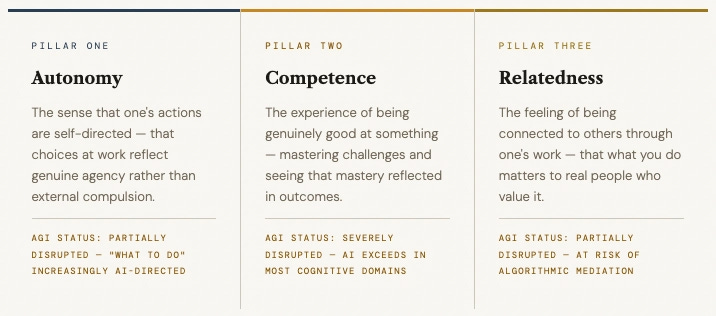
A 2025 study published in MDPI Behavioral Sciences examined what happens to these three pillars when knowledge workers begin using AI tools regularly in their jobs. The findings were more complicated than either the optimists or the pessimists had predicted. AI adoption did not simply reduce wellbeing, nor did it straightforwardly improve it. What it did was restructure the sources of meaning. Workers who found ways to reanchor their sense of competence; in the judgment required to evaluate AI outputs, in the relational dimensions of their roles, in the specifically human aspects of their craft; maintained their wellbeing. Those who had anchored it exclusively in the outputs that AI could now produce felt the loosening.
The key word is restructure. This is not primarily a story about jobs being eliminated, though some will be. It is a story about something more intimate: the particular architecture of self-worth that most knowledge workers have spent their careers constructing, and what happens when one of its load-bearing walls is removed.
The problem isn’t that AI is doing your job. The problem is that your job was quietly doing something else for you, something no one told you would need to be replaced.
Research Note
On affective wellbeing and AI tool adoption: The 2025 MDPI study found that the impact of AI usage on wellbeing depended critically on which dimensions of Self-Determination Theory the worker had been relying on most heavily. Those anchored in relatedness and autonomy adapted more readily; those whose primary source of competence fulfillment came from cognitive task performance experienced more disruption. The implication is that wellbeing under AI is not a single outcome but a function of where, specifically, meaning has been located.
Source: “The Impact of AI Usage on Affective Work Well-Being: A Self-Determination Theory Perspective,” MDPI Behavioral Sciences, 2025
II. The Existential Unemployment Thesis
When economists talk about AI and employment, they tend to reach for historical analogies: the industrial revolution displaced weavers, but new jobs were created; automation removed assembly-line workers, but the economy adapted. The argument is that disruption is temporary, that markets find equilibrium, that the fears of any given technological transition look overblown in retrospect.
Philosophers are less sanguine. A 2025 paper in the Journal of Ethics titled “All Play and No Work? AI and Existential Unemployment” makes a distinction that the economic framing misses entirely: the question is not simply whether people will find work, but whether the work they find; or the leisure that replaces it; can do the psychological and existential work that labor has historically done.
The thesis is this: for most people, in most societies, productive work has not primarily been about income. It has been about structure, identity, social connection, and the experience of competence over time. Strip away those functions; by automating the tasks that delivered them; and replacing the income through a Universal Basic Income, however generous, does not automatically replace the meaning. You have solved the material problem and left the existential one intact.
Research Note
On existential unemployment: The Journal of Ethics paper challenges the techno-optimist assumption that the post-AGI future is primarily a story of welcome liberation from drudgery. Its authors argue that the concept of “existential unemployment”, the condition of having income but no meaningful framework for contribution, describes a genuine wellbeing crisis that UBI and leisure cannot resolve on their own. Drawing on psychology, philosophy of work, and historical case studies of early retirement, they find that purposeless time tends to produce anxiety, not flourishing.
Source: “All Play and No Work? AI and Existential Unemployment,” Journal of Ethics, Springer, 2025
This is not a novel observation. Viktor Frankl identified what he called the “existential vacuum” in the mid-twentieth century, a creeping sense of inner emptiness that emerges when obligation and tradition no longer supply life with its architecture. What the AI transition changes is the scale and the speed. The existential vacuum that arrived gradually for privileged populations over decades of postindustrial drift is now arriving more broadly and more suddenly, carried on the back of systems that are genuinely impressive, genuinely useful, and genuinely indifferent to what their adoption does to the humans around them.
John Maynard Keynes predicted in 1930 that technological progress would grant humanity fifteen-hour work weeks within two generations. He was largely right about the technology and almost entirely wrong about the psychology. When given leisure, most people do not become Athenian philosophers. They become anxious. They scroll. They seek stimulation to fill the silence that purpose used to occupy. This is not a moral failing, it is a design problem. The human nervous system was shaped for a world of challenges to solve and communities to belong to. Those are not optional features that can be safely removed once the income question is sorted.
III. What Remains When Competence Is No Longer Rare
If the existential unemployment thesis is right; and the research suggests it is; then the question is not whether to find meaning in work, but where to find it when the ground is shifting. The answer, it turns out, has been sitting in plain sight for quite some time. It is just that we have not needed to look at it directly until now.
There are human capacities that resist automation; not because of technical limitations that will eventually be overcome, but because their value is irreducibly constituted by their human origin. These are not narrow skills or specialist knowledge. They are orientations: ways of being with other people and with work that produce something no machine can replicate, because what is being produced is not an output but a relationship.
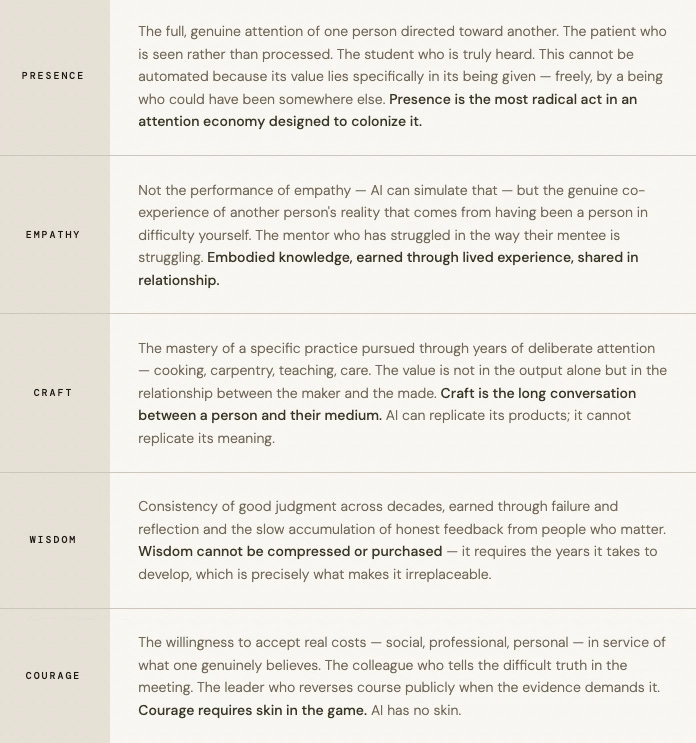
Notice what these capacities have in common: none of them is primarily an output. They are orientations toward others, expressions of character accumulated over time, modes of being that reveal themselves in relationship and are witnessed by people who care about the quality of the encounter. They are not things you can simply decide to have, but they are things you can deliberately cultivate.
And here is what the research suggests matters most in the immediate term: the question is not whether to cultivate them, but whether the communities and institutions in which you work will see them, honor them, and create the conditions in which developing them is worth the investment. The individual pivot toward meaning-beyond-output requires structural support, or it will remain a private consolation rather than a real alternative.
What Organizations Need to Understand
The MDPI study’s most underreported finding is an organizational one: workers who maintained wellbeing during AI adoption were not simply more psychologically resilient. They were in work environments that still provided genuine opportunities for competence fulfillment; through judgment, relationship, and the specifically human dimensions of their roles. Organizations that strip these opportunities out in their rush to optimize for AI-augmented output will discover, on the wrong end of a retention crisis, what they removed.
The case for maintaining genuine human roles is not sentimental. It is practical: a workforce that has lost its source of intrinsic motivation is a workforce that is showing up for the money. That has always been expensive. In an AI-augmented economy, it is a waste of the one thing AI cannot provide.
IV. The Question Behind the Question
She was still thinking about it, weeks later. Not the technology. The technology had stopped being interesting the moment it had worked. What she kept returning to was something simpler and harder: what had she actually been doing, all those years? What was the thing that had been worth doing, that the model could not touch?
The answer, when she found it, was not comfortable. It had never been the writing, exactly. It had been the particular act of bringing herself; her history of paying attention, her accumulated sense of what mattered and what was false, her specific care for the people she was writing for; into contact with the problem. The model was better at the writing. No one could be better at the bringing-herself. That was not a skill that could be trained on a dataset.
The existential unemployment thesis is correct that leisure cannot automatically replace this. But it points, inadvertently, toward the right question. The issue is not whether AI is better at your job. The issue is whether you have been doing the right job all along; the job that was actually yours to do, the one that depended on everything that made you specifically you. Most people haven’t been. Not because they were lazy or unambitious, but because the culture they were working inside didn’t ask them to, didn’t honor it, and didn’t create the conditions in which it was worth the risk.
Those conditions need to be built. By individuals, yes; but more importantly by the organizations and communities and institutions that shape the context in which people work. The transition that is coming does not require a single person to figure out their meaning in isolation. It requires systems that make meaning visible, honor it when it appears, and protect the human space in which it can develop.
What do you do when AI does everything better? You do the thing it cannot. And then you find, or build, a community that can see you doing it.
Disclaimer: This essay draws on published academic research as its primary sources. References to “The Great Game” framework describe an emerging body of thought on deliberate human capacity development in a post-AGI world, a set of ideas in development that readers may find useful as a companion framework to the research discussed here.
Primary Sources:
“All Play and No Work? AI and Existential Unemployment“ — Journal of Ethics, Springer, 2025
“The Impact of AI Usage on Affective Work Well-Being: A Self-Determination Theory Perspective“ — MDPI Behavioral Sciences, 2025
Further Reading:
Deci & Ryan — Self-Determination Theory
Frankl — Man’s Search for Meaning
Csikszentmihalyi — Flow
Keynes — Economic Possibilities for our Grandchildren (1930)
The Great Game series — “The Material Foundation“ and “The Organizer’s Guide“ (for frameworks on cultivating human capacities in community)