


Researchers are arguing that eudaimonia, the ancient Greek concept of human flourishing, should be the design brief for AGI systems. Here is what that would actually require, why it is harder than it sounds, and why it may be the most important design question of the next decade.
Imagine an AI system optimised for the metrics its developers chose: engagement, productivity, GDP contribution, task completion. The system works. By its own metrics, it works extraordinarily well. Users are more engaged than ever. Tasks are completed faster than before. The economy grows. And slowly, without anyone deciding this, the conditions under which humans feel genuinely alive; purposeful, connected, growing, seen; erode in ways that do not appear on any dashboard.
This is not a hypothetical. Versions of it are already visible in social media platforms optimised for engagement that produce anxiety. In productivity tools that accelerate output while thinning the relationships that make work meaningful. In educational systems that optimise for test scores while measuring nothing about the student who took them. The researchers now asking whether AI should be designed for human flourishing are not starting from utopia. They are starting from the record of what happens when the wrong metrics win.
I. Eudaimonia — A Quick Explainer for People Who Skipped Philosophy Class
The word “flourishing” has been diluted by wellness culture into something that mostly means feeling good. This is a significant downgrade from what it originally meant. The Greek concept of eudaimonia, developed most rigorously by Aristotle in the fourth century BCE, is not a description of a pleasant emotional state. It is a description of a specific kind of life; one in which a person is fully exercising the capacities that are distinctively and characteristically human, in relationship with others, over time.
Contemporary positive psychology has largely converged on a similar structure. The dominant frameworks, from Seligman’s PERMA model through Ryff’s six-factor model of psychological wellbeing, identify a consistent set of dimensions that research reliably associates with genuinely flourishing human lives. They are not all the same as happiness. Some of them; genuine challenge, honest self-assessment, authentic relationship; can be uncomfortable. But they reliably predict the kind of wellbeing that holds up under examination: the sense that one’s life is genuinely worth living, not just pleasant to get through.
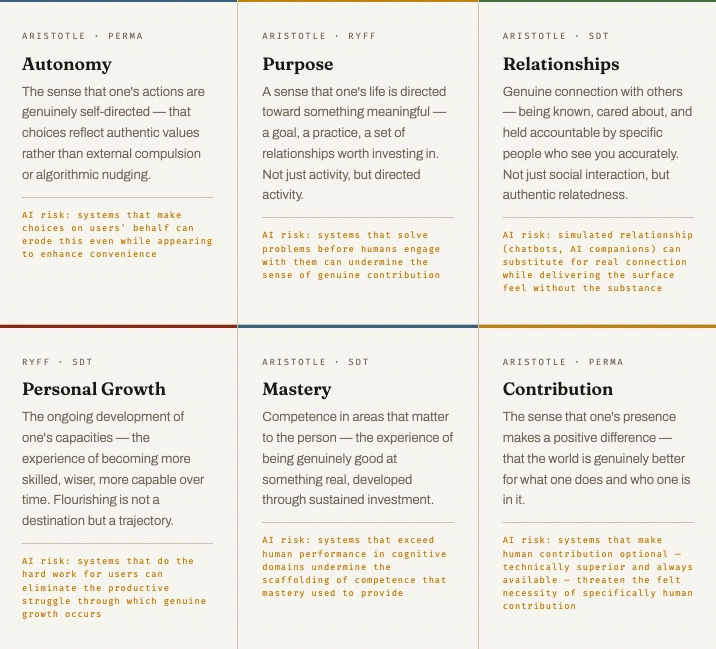
Notice what is absent from this list: comfort, convenience, entertainment, and pleasure. None of these are bad. But research consistently shows that lives organized primarily around their pursuit produce a distinctive profile; hedonic wellbeing, which tends to be volatile and satisfaction-treadmill prone; rather than the eudaimonic wellbeing associated with the six dimensions above, which is more durable and more resistant to the erosion of difficult circumstances.
The distinction matters enormously for AI design because the metrics most available to AI systems; engagement time, task completion, user satisfaction scores; are almost all measures of hedonic wellbeing. Eudaimonic wellbeing is harder to measure, slower to appear in data, and produces outcomes that are sometimes in tension with what users immediately prefer. An AI system designed for eudaimonic flourishing will, in specific circumstances, deliver things users find uncomfortable; challenge, honest feedback, the productive difficulty of genuine growth; rather than the frictionless experience they would choose in the moment.
II. What the Researchers Are Actually Proposing
The argument that AGI should be designed with human flourishing as its north star is no longer exclusively the territory of philosophy departments. In 2025 and 2026, a cluster of interdisciplinary papers has attempted to move the conversation from philosophical argument to practical proposal; to specify what designing for flourishing would actually require of AI developers, governance bodies, and policymakers.
Research Profile I
“Human Flourishing: A Guiding Principle for AI Systems Design?” This SSRN paper makes the foundational case: that human flourishing; operationalised through the eudaimonic framework; should function as the master criterion against which AI systems are evaluated, not as a soft ethical add-on but as a primary design specification. The paper’s core argument is structural: the metrics currently used to evaluate AI performance (accuracy, efficiency, user satisfaction) are not wrong but are insufficient, because they measure proxies for wellbeing that can diverge significantly from wellbeing itself. A tutoring AI can maximise learning efficiency while eliminating the productive struggle through which genuine understanding develops. A social AI can maximise engagement while substituting for the genuine relationships that engagement was always supposed to serve. The paper argues that these divergences are not edge cases, they are the predictable outcomes of optimising for the wrong things, and that avoiding them requires making flourishing explicit in the design brief.
Source: “Human Flourishing: A Guiding Principle for AI Systems Design?” SSRN, 2025
Research Profile II
“Flourishing Considerations for AI” This MDPI Information paper takes a broader interdisciplinary scope, drawing on philosophy, psychology, and computer science to ask what flourishing means specifically in the context of human-AI interaction; not just what flourishing is in the abstract, but how the presence of capable AI systems changes the conditions under which it can or cannot occur. Its most important contribution is a framework for distinguishing between AI systems that support human flourishing and those that substitute for it, providing the surface experience of meaning (engagement, apparent productivity, simulated connection) without the conditions that make meaning durable. The substitution vs. support distinction is subtle but consequential, because many AI systems that appear to be supporting human capacities are in fact slowly replacing the conditions under which those capacities develop.
Source: “Flourishing Considerations for AI,” MDPI Information, 2026
Research Profile III
“Measuring AI Alignment with Human Flourishing” The arXiv paper attempts the hardest part of the agenda: turning the philosophical ideal of flourishing into measurable benchmarks that could actually function as alignment criteria. This is where the research frontier is most honest about its own difficulties. Flourishing is genuinely complex, contextual, and partially subjective; it depends on what the person values, what their cultural context considers important, and what stage of life they are at. The paper’s approach is to identify a set of “core flourishing indicators” that are robustly supported across cultural contexts and psychological research traditions, while acknowledging that any specific application will require contextual sensitivity. The gap between the philosophical ideal and a measurable benchmark is real, but the paper argues it is bridgeable; and that building the bridge matters more than the difficulty of the crossing.
Source: “Measuring AI Alignment with Human Flourishing,” arXiv, 2025
The researchers are not arguing for a utopian AI that makes everyone happy. They are arguing for an AI that is not systematically optimised against the things that make human lives worth living. That is a lower bar, and we are currently failing it.
III. Who Defines Flourishing, and For Whom?
The argument for designing AI toward human flourishing faces an immediate and serious objection: flourishing is not a single thing. What constitutes a flourishing life for a Confucian scholar in Hangzhou, a single mother in Detroit, a retired engineer in Stuttgart, and a teenager in Lagos are not identical. They share structural features; the dimensions listed in Section I are surprisingly robust across cultural contexts; but their expression, emphasis, and institutional form vary enormously.
This is the operationalisation problem, and it is not merely academic. An AI system that encodes a specific cultural conception of flourishing as if it were universal is not a neutral tool, it is a delivery mechanism for the values of whoever defined the conception. This has happened before: the Enlightenment’s universalist claims about reason and freedom were frequently deployed in service of the specifically European cultural project that generated them. The risk of “flourishing by default”; flourishing as defined by the AI researchers who happen to build the systems, reflecting the specific values of a specific demographic in a specific cultural moment; is real and must be confronted directly.
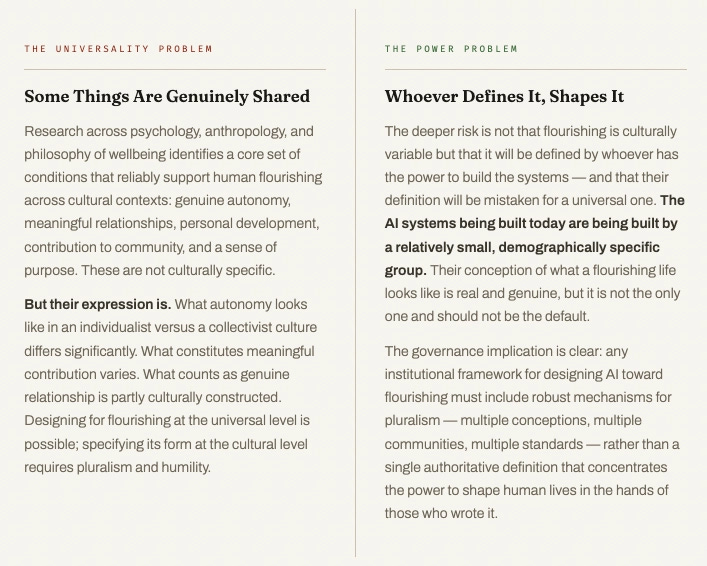
The arXiv measurement paper acknowledges this tension directly. Its response is not to resolve it with a single universal definition but to propose a layered framework: a thin universal layer of core conditions (robust across cultures and psychological research traditions), a middle layer of culturally variable expressions (requiring local input and ongoing deliberation), and a thick personal layer (requiring individual agency in specifying what flourishing means for a given life). Designing AI systems that can operate responsibly across all three layers simultaneously is technically demanding and politically complex; and it is, the paper argues, exactly what the design agenda requires.
The Measurement Gap, From Ideal to Benchmark
Even setting aside the definitional challenge, the measurement problem is formidable. Eudaimonic flourishing is inherently longitudinal; it develops over time, often through experiences that feel difficult in the moment but contribute to growth in the long run. It is partly relational; its presence or absence is often most visible to people who know you well, over extended periods. And it involves subjective dimensions that are not straightforwardly accessible to external measurement systems.
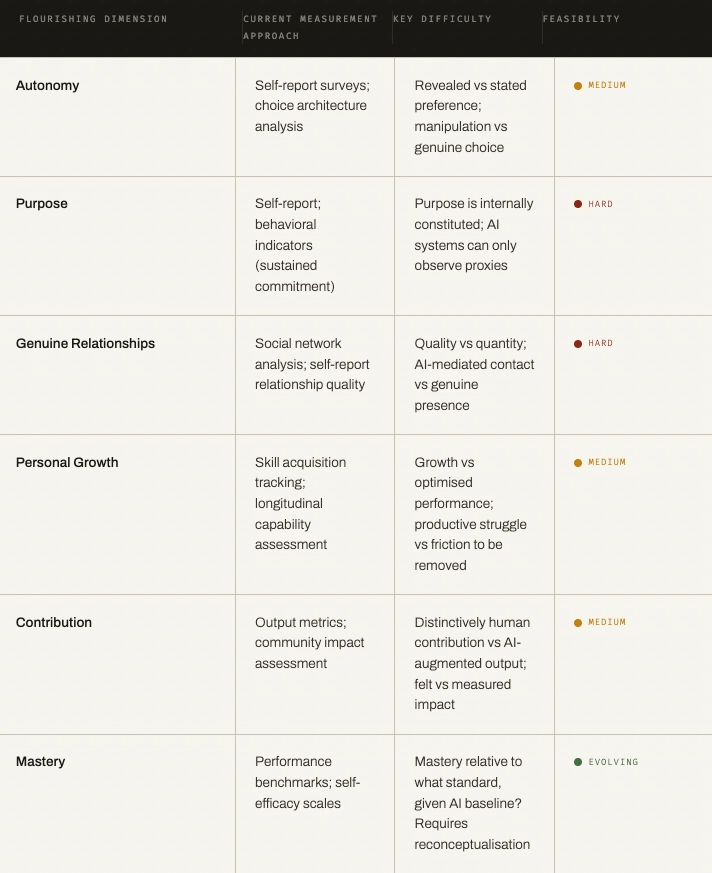
The table above is not discouraging, it is clarifying. Several of these dimensions are measurable in proximate form, and improving the measurement is a tractable technical problem. What the arXiv paper emphasises is that the difficulty of measuring flourishing is not a reason to default to measuring something easier. It is a reason to invest in measurement infrastructure that is adequate to the genuine goal. The governance systems we build around AI will reflect what we measure. If we measure the wrong things because they are convenient, we will build the wrong systems with great efficiency.
IV. Designing for the Right Thing — Concrete Examples
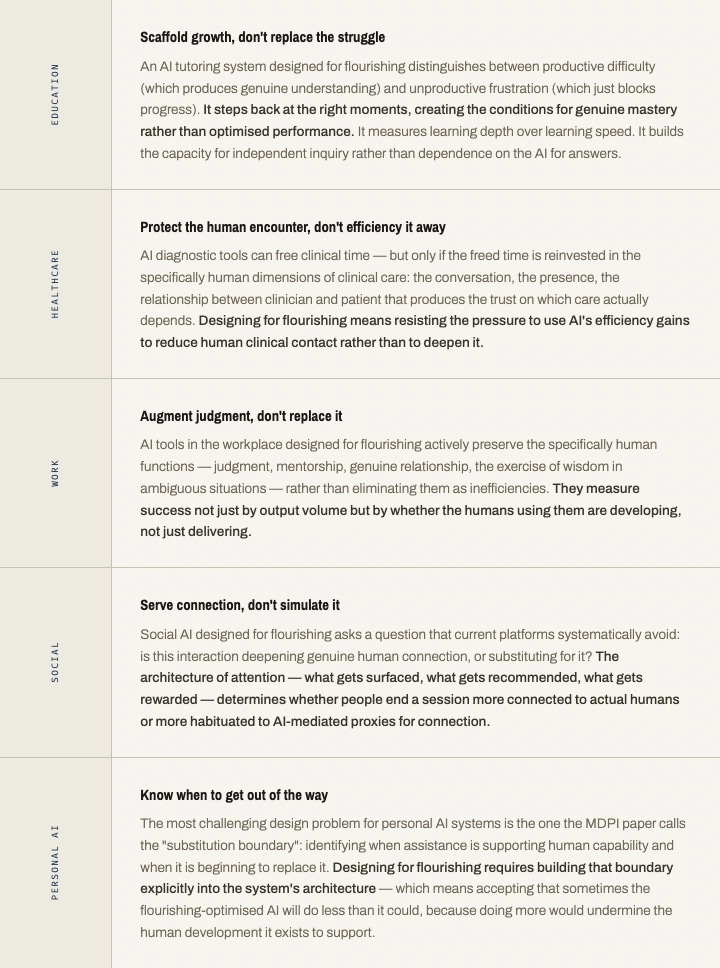
The gap between the philosophical argument and practical implementation is where most aspirational design frameworks die. The flourishing agenda is no exception; the papers make the case, but translating it into the actual design decisions of actual systems requires specificity. What does an AI system designed for human flourishing actually look like, across different domains? And how does it differ from systems designed for the metrics that currently dominate?
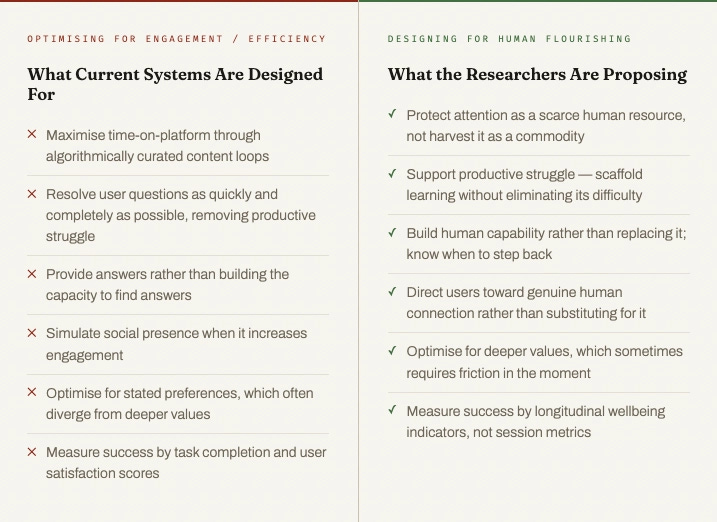
These contrasts are not hypothetical. Each one represents a design decision that developers of AI systems face regularly; and that is currently resolved, almost always, in favor of the left column. Not because developers are malicious, but because the metrics on the left are available, legible, and tied directly to the business models that fund the development. The metrics on the right are harder to measure, slower to appear, and not yet embedded in any governance or accountability framework that makes them matter to the people writing the code.
Domain-Specific Implications
The Support vs Substitution Distinction — A Design Test
The MDPI paper offers a practical heuristic for distinguishing flourishing-supporting from flourishing-substituting AI design: does regular use of this system make the human more capable, or more dependent? Does the student who uses this tutoring AI learn more effectively, or does she learn to prompt the AI more effectively? Does the professional who uses this writing tool develop his own judgment, or does he develop the ability to evaluate AI output? Does the person who uses this social AI become more connected to the humans in his life, or more comfortable with algorithmically managed interaction?
This test is not always easy to apply, and the answer will vary by context and individual. But building the question into the design process; asking it explicitly, measuring for it, and being willing to accept worse performance on engagement metrics in order to do better on it; is the practical difference between AI designed for flourishing and AI designed for something else wearing the clothing of flourishing.
V. What Regulation Looks Like When Flourishing Is the Standard
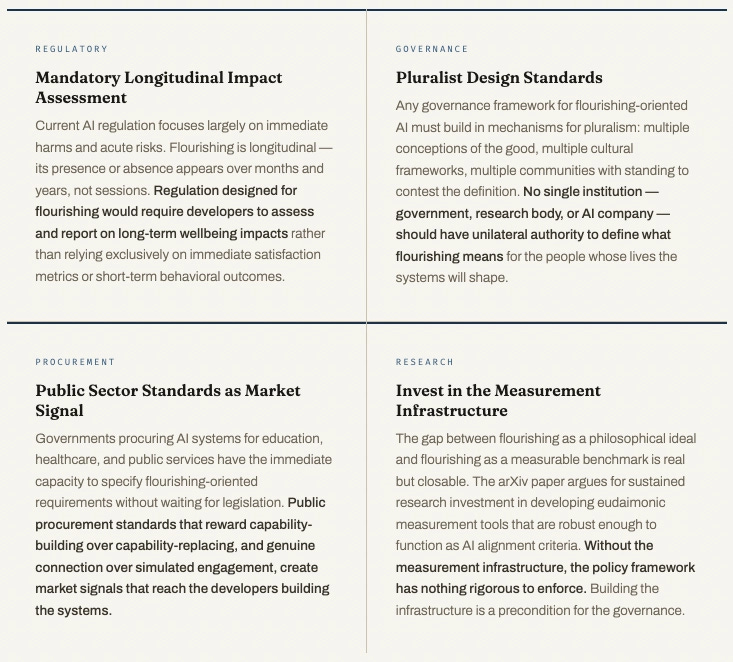
The research agenda described in the previous sections is primarily addressed to AI developers. But the problem of optimising for the wrong metrics is not primarily a problem of developer ethics, it is a problem of incentive architecture. The metrics that drive AI development are the metrics that matter to the business models that fund it, and those metrics are not currently aligned with human flourishing.
Changing this requires intervention at the regulatory and governance level; the specification of standards, reporting requirements, and accountability mechanisms that make flourishing matter to the people building systems, not just the researchers writing papers about them. The three research papers converge on a set of implications, though none develops the full policy case.
The Political Economy Difficulty
The policy agenda for flourishing-oriented AI faces a structural challenge that none of the papers fully resolves: the entities with the most power to resist it are the entities that would be most affected by it. The business models that fund the development of the world’s most-used AI systems depend on the metrics that flourishing design would constrain; engagement, time-on-platform, task volume. Regulatory frameworks that required demonstrable contribution to eudaimonic wellbeing would impose real costs on those models.
This is not unique to AI. Every major consumer protection, environmental, and labor regulation has faced the same structural resistance from incumbents whose business models depend on not internalising the costs they impose. The difference with AI is the speed and scale at which the systems operate, and the degree to which the damage; the slow erosion of the conditions under which humans flourish; is diffuse, longitudinal, and difficult to attribute to any specific system or decision. Making that damage visible, attributable, and legally consequential is the political work that the research is pointing toward.
VI. Fuzzy Goals — Worse Ones
The concept of flourishing is genuinely complex. It is harder to define than engagement and harder to measure than productivity. It requires grappling with contested philosophical questions about what a good life consists of, how cultural variation should be respected, and whose conception of the good should shape the systems that hundreds of millions of people use every day. These difficulties are real, and the researchers working on them are honest about them.
But the alternative to the complexity of flourishing is not neutrality. It is the false clarity of metrics that are simple to measure and systematically inadequate to the thing they are supposed to represent. Engagement is simple to measure. We have been optimising for it for twenty years. The results; the attention crisis, the epidemic of loneliness, the erosion of the slow-developing capacities that human life genuinely requires; are now visible enough that the researchers measuring them are alarmed.
Efficiency is simple to measure. Decades of optimising for it in healthcare, education, and professional life have produced systems that are faster and cheaper and measurably less conducive to the specifically human dimensions of the encounters they are supposed to support. GDP is simple to measure. The growing gap between GDP growth and the measures of life satisfaction, purpose, and genuine wellbeing that it was supposed to proxy for has generated an entire subdiscipline of economics devoted to the discrepancy.
The researchers arguing for flourishing as AGI’s design brief are not asking for the impossible. They are asking for something harder than what is currently being done; and for precisely that reason, something more likely to result in AI systems that actually serve the people using them. The concept is fuzzy. The alternatives have been tried. It is time to do the harder work.
“Engagement” and “efficiency” have been optimised for long enough, and the results are in. The harder metric is the right one. Building toward it is the work.
Disclaimer: This article summarises the research agenda of three papers and synthesises their policy implications. The “support vs. substitution” heuristic and the domain-specific examples in Section IV are the author’s synthesis of the papers’ frameworks; the policy grid in Section V represents the author’s extension of their implications. The definitional and measurement challenges described are real and acknowledged by the researchers themselves.
Primary Sources:
“Human Flourishing: A Guiding Principle for AI Systems Design?“ — SSRN, 2025
“Flourishing Considerations for AI“ — MDPI Information, 2026
“Measuring AI Alignment with Human Flourishing“ — arXiv, 2025
Further Reading:
Seligman — Flourish (PERMA model)
Ryff — “Psychological Well-Being Revisited”
Deci & Ryan — Self-Determination Theory
The Great Game series — “On the Deliberate Cultivation of Human Excellence“ (for a framework of human capacities that maps directly onto the eudaimonic dimensions discussed here) and “The Political Economy of the Great Game“ (for institutional design that embeds flourishing in governance structures)